USA's Top Daily Chess News Blog, Informative, Fun, and Positive
hosted by Chess Queen™ & 12th Women's World Chess Champion Alexandra Kosteniuk
Wednesday, November 19, 2014
World Chess Championship Trivia: Identify Photo
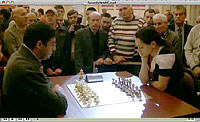
Hello chess blog friends, we have a 'vintage' chess trivia question for you - can you identify the players in this chess photo and say what is its significance? Find the answer to the question by clicking on the photo.
Trivia Chess History: Identify this Coach to Boris Spassky, Anatoly Karpov
Chess Blog for Daily Chess News and Trivia (c) Alexandra Kosteniuk, 2014
Hello everyone,
Who's this swashbuckling strong chess Grandmaster who was coach to both Anatoly Karpov and Boris Spassky. You can find, at Chess King, a nice chess puzzle from one of his games played as White.
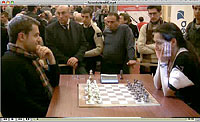
Chess History Photo Trivia Quiz: Name the Grandmasters, Place, Year
Chess Blog for Daily Chess News and Trivia (c) Alexandra Kosteniuk, 2013
Hello everyone,
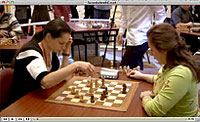
How well do you know your chess history? Who are the Grandmasters in this photo? Where was this game played and when? (This photo is via USChessTrust).
5000-Year-Old Tokens of 'Chess-Like' Game found in Turkey
Alexandra Kosteniuk's Chess Blog for Daily Chess News and Trivia (c) 2013
Hi everyone,
A series of immaculately preserved stone tokens have been discovered at a 5,000 year-old burial site in Turkey. They could be the oldest gaming tokens ever found, say archaeologists.
A total of 49 stones were found, all painted different colours and depicting pigs, dogs, pyramids and other shapes. "It's a unique finding, a rather complete set of a chess-like game. We are puzzling over its strategy," Haluk Sağlamtimur of Ege University in İzmir told Discovery News, who initially reported it.
Similar stones have been found before in Syria and Iraq, said Sağlamtimur, while presenting his findings at a symposium in Turkey, but only as individual items and never as a collection. The stones were accompanied by dice, circular tokens and poorly preserved wooden sticks, which the archaeologists are hoping will shed some light on the rules of the game.
It's thought that board games originated in the Middle East. The Egyptian game Senet, which means "game of passing", is widely recognised as the earliest fully understood board game, dating back to around 3100 BC. Board games are known to have been a popular pastime in ancient Mesopotamia, which included areas of modern-day Iraq, Syria, Turkey and Iran. In the 1920s, Sir Leonard Woolley discovered two game boards dating from around 2600 BC, from a game known as the Royal Game of Ur, or Game of Twenty Squares. One of the boards is currently exhibited in the British Museum in London.
Most of the earliest games discovered are race games based around tiled boards, although historians often disagree about the rules. A set rules for the Royal Game of Ur were written on a tablet of Babylonian origin -- also displayed in the British Museum -- but two separate sets of rules have been proposed for Senet, both of which have been adopted by companies that sell the game today. Historians are already puzzling over the rules for the new tokens, but suspect gameplay is based around the number four.
Chess Queen Kosteniuk writes History in Switzerland
Alexandra Kosteniuk's Chess Blog for Daily Chess News and Trivia (c) 2013
Hi everyone,
We have some great chess news to share. For the first time in Switzerland’s 113-year chess history, a woman has been able to win both the women’s and men’s national chess titles. Chess Queen™ Alexandra Kosteniuk has conquered the top step on both podiums recently in Grächen, Switzerland. Read all about it on her personal blog at www.chessqueen.com. There are lots of exclusive photos of the event in the post.
Exploring Medieval European Society with Chess: An Engaging Activity for the World History Classroom
12th Women's World Champion Alexandra Kosteniuk's Chess Blog for Latest Chess News and Trivia (c) 2013
Hi everyone,
Here is a detailed article by John Pagnotti and William B. Russell III for those interested in history and how chess could help make studying history cool! Excerpts: The History Teacher, Volume 46:1 (2012)
Effectively teaching World History requires that teachers foster a learning environment that is challenging, interactive, engaging, meaningful, and relevant for the learner. Infusing a game activity into the curriculum offers a way to create a highly interactive and engaging learning environment while supporting meaningful content acquisition.
The purpose of this article is to help educators explore the strategy of using the game of chess in the World History classroom. More specifically, it provides educators with a classroom-tested lesson activity for teaching medieval European society content using the game of chess by providing background information on the history of chess, a rationale for including chess in the classroom, and step-by-step procedures to infuse this activity when the topic of feudalism is covered.
Chess blog for latest chess news and chess trivia (c) Alexandra Kosteniuk, 2013
Hi everyone,
Here is an old photo from the GM Chess Tournament held in the Kerkau-Palast, Berlin, from September 28 to October 11, 1918. Can you name all the players and the event organiser (standing)?
Chess blog for latest chess news and chess trivia (c) Alexandra Kosteniuk, 2012
Hi everyone,
This photo comes from the Cleveland Public Library's Digital Collection. Can you name the strong chess player and her claim to fame? Check out the answer right here on Chess Blog over the weekend. Happy chess-history hunting!
Chess blog for latest chess news and chess trivia (c) Alexandra Kosteniuk, 2011
Hello everyone,
Enjoy the History of chess clocks in this clip from Postcard Videos Travel Series DVD on The World Chess Hall of Fame and Sidney Samole Chess Museum. Of course, this video is from when the Chess Hall of Fame was in Florida, Miami. Can you tell us where the Chess Hall of Fame now?
Today I got an email from my chess friend James from England about his new site www.isleoflewischessset.co.uk which is all about the wonderful Isle of Lewis Chessmen.
These chess pieces have become legends since they were discovered on the Isle of Lewis (Scotland, UK) in 1831. The exact history of the chessmen is often disputed but the conventional theory is that they were hand carved around 1150 -1200 AD in Norway. In 1831 they were re discovered when a sand bank collapsed and revealed a chest that had been buried years earlier. In the chest was ninety three figures which are now known as the Lewis Chessmen.
Arguments and battles rage on today about the chessmen, often about where they should be exhibited. Currently they reside in museums in the UK. There is also a theory that they were not in fact chess pieces, but figures from a totally different game. Today however they have become accepted as iconic chessmen and reproduction commercial sets adorn chess boards the world over. The Lewis chessmen have become a tourist attraction for the Isle of Lewis, there is even a huge model of the king near the place where the chessmen were found all those years ago.
Chess news and chess trivia blog (c) Alexandra Kosteniuk, 2010
Fide President Kirsan Ilyumzhinov
Hi Everyone,
The Bulgarian city of Plovdiv could have links to the origin of chess, according to Fide President Kirsan Ilyumzhinov.
In an interview for the Russian Kommersant daily, Ilyumzhinov said he discussed with Bulgarian officials the possibilities of staging the first international conference on history and origins of chess in Sofia.
The FIDE states that India is only one possible places of origin of chess. "This is one version. But do you know that ancient chess pieces have been found in Plovdiv? And this is one of the oldest cities in Europe. There are still theories about which country is the birthplace of chess. We first talked about India, then - about Persia. Last year I was in Mongolia, and its president showed me chess pieces found found in the tomb of Genghis Khan and the excavated burial mound. Check out their approximate age - they turned out to be 3 500 years old. The oldest chess pieces in India are maximum 2000 years old ... Chess pieces have also been found in Latin America, in Peru. How did they end up there?" Ilyumzhinov asked.
Don't be shy about contacting me
to share women's chess news
or to propose collaboration
Best chess wishes to you! Alexandra Kosteniuk
12th Women's World Chess Champion
Facebook, Twitter, Youtube