Alexandra Kosteniuk Defends Master Thesis on Preschool Chess Education
How Chess can Make you Smarter: Gelfand Joins Haifa University Research Project
Chess blog for latest chess news and chess trivia (c) Alexandra Kosteniuk, 2012
Hi everyone,
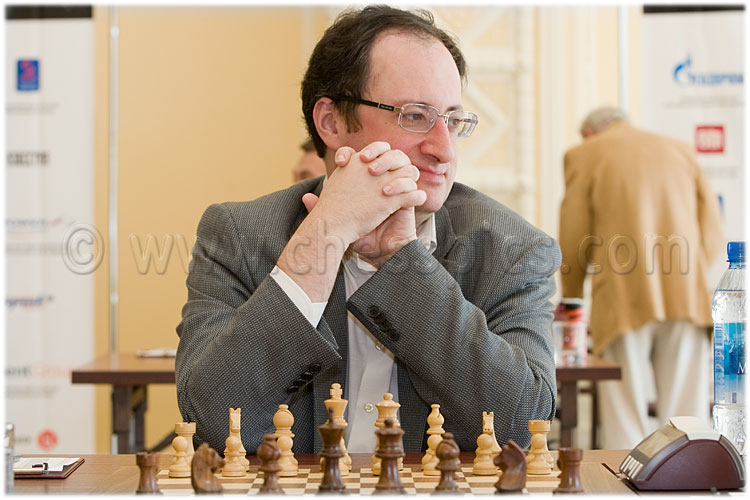
Boris Gelfand, Israeli chess grandmaster, and the University of Haifa have teamed up to prove that chess can make you smarter and better adjusted, according to a Jewish Press news report.
The Grandmaster Chess Research Project will investigate the role chess-playing skills can contribute to social and scientific development, and made lead to the development of Hebrew-language educational products teaching and drawing on chess as a way to enhance cognitive abilities.
According to a report by Israel21c, the project will examine how chess players achieve in the fields of language, math, and other academic arenas.
The report states that numerous studies on the benefits of chess have already shown that the game improves reading abilities, and is associated with higher grades in school, as well as improved concentration, self-discipline, logic, and other behaviors.
Israeli interest in chess has grown significantly since Gelfand’s second-place win at the Chess World Championship 2012.
From Alexandra Kosteniuk'swww.chessblog.com
Also see her personal blog at
www.chessqueen.com
Don't miss Chess Queen™
YouTube Channel
Labels: Boris gelfand, chess research, haifa university
Chess Research Project with Vice World Champion Grandmaster Boris Gelfand
Chess blog for latest chess news and chess trivia (c) Alexandra Kosteniuk, 2012
Hi everyone,
Photo: (L-R) Rosa Leikin, Head of the Interdisciplinary Center for Research and Advancement of Excellence and Giftedness; VP and Dean of Research Prof. Michal Yerushalmy; Grandmaster Boris Gelfand; Maya Gelfand; Shay Bushinsky; Adv. Doron Schweppe, Legal Advisor
A one-of-a-kind initiative to establish a ‘Grandmaster Chess Research Project’ is taking shape at Israel’s University of Haifa in collaboration with vice world chess champion Grandmaster Boris Gelfand. The program is set to develop a novel academic approach to the skills and culture of chess-playing that can in turn contribute to social and scientific development. The program will include research on the correlation between chess and cognitive enhancement; develop the first Hebrew-language educational software program for teaching chess in schools and kindergartens; and establish an international program for training chess instructors and coaches.
“This initiative is introducing chess and the disciplines involved in the game’s development into the academic world as never before,” says Vice President and Dean of Research Prof. Michal Yerushalmy. “Through advanced studies in the University’s Department of Computer Sciences and other innovative facilities and with the ongoing guidance of Grandmaster Boris Gelfand, the program will provide an opportunity to achieve breakthrough research and social outreach in a field that has not yet been fully explored,” she explains. “The University of Haifa is home to some of the best minds in cognitive and developmental research and is well positioned to examine the impact of chess on students’ math skills, language acquisition, and other skills.”
At a festive reception with Grandmaster Gelfand - winner of the 2009 World Cup and of the 2011 Candidates’ Matches – University of Haifa Vice President for External Relations Amos Gaver congratulated him on his accomplishment in the 2012 World Championships and for the pride that he brings Israel. Along with Prof. Yerushalmy and University of Haifa researcher and chess software developer Shay Bushinsky, Amos Gaver presented the new chess research initiative to the grandmaster.
“I am honored that the University of Haifa has decided to develop studies connected to chess and I do believe that through these studies we can help children and people of all ages develop their interest and play chess. I am sure this will make our society better - I know people leading in intellectual professionals who succeeded thanks to their playing chess in school and continued playing alongside their professional development,” said Gelfand.
The University of Haifa’s Grandmaster Chess Research Program will initiate and take part in multiplatform collaborations with international experts and grandmasters to explore the multidisciplinary aspects of chess (such as the scientific, cognitive, political, cultural and historic); will work to promote the inclusion of chess in school curricula; and will develop the first comprehensive educational software program in Hebrew for chess instruction.
From Alexandra Kosteniuk's
Also see her personal blog at
Don't miss Chess Queen™
Labels: Boris gelfand, chess research
Play Chess to Keep Brain Fit: New Study by Radiological Society of North America
Chess blog for latest chess news and chess trivia (c) Alexandra Kosteniuk, 2012
Hi everyone,
Researchers from Rush University Medical Center and Illinois Institute of Technology in Chicago, who studied the effect of late-life cognitive activity on the brain’s white matter, have concluded that reading newspapers, writing letters and playing games like chess, do contribute to a healthier brain.
The researchers used a magnetic resonance imaging (MRI) method known as diffusion tensor imaging (DTI) to generate data on diffusion anisotropy, a measure of how water molecules move through the brain. In white matter, diffusion anisotropy exploits the fact that water moves more easily in a direction parallel to the brain's axons, and less easily perpendicular to the axons, because it is impeded by structures such as axonal membranes and myelin.
Read more »Labels: chess and science, chess research, radiological society of north america
Saturday Chess Forum: Do You Get Physically Exhausted After Playing Chess?
Chess blog for latest chess news and chess trivia (c) Alexandra Kosteniuk, 2012
Hi everyone,
We found a nice update about a chess research in Shelby Lyman's column for the Colombus Dispatch today. He writes: Researchers at Temple University found in 1971 that the pulse and respiratory rates of chess players during peak moments of a game were comparable to those of boxers and football players during competition. A clue to understanding these findings is the Russian notion that a chess game is a debate. Imagine an intense argument that lasts four or five hours without relief. Could not the equivalent in a chess competition wreak physical and psychological havoc — especially for those who are obliged to play day after day with only an occasional respite?

Chess struggles can have a mind-boggling intensity. Each move by the opponent potentially introduces new threats and dangers. A surprise move or a material sacrifice can instantly raise the level of stress.
Imagine also the clock ticking away, an intense audience of aficionados nearby and on the Internet, a press room full of rival grandmasters second-guessing each play, and future players poring over each move and mistake. It’s not surprising that perennial Russian world champion Mikhail Botvinnik, a sober man and scientist, posited that each world-championship match could cost him two years of his life.
______________________________________________
Saturday Chess Forum
What do you think? Do let us know! Have a great chess weekend.
From Alexandra Kosteniuk's
Labels: chess forum, chess research, mikhail botvinnik
Chess Experts Help Researchers Understand How We See the World
Chess blog for latest chess news and chess trivia (c) Alexandra Kosteniuk, 2012
Hello everyone,
We are always interested in all the research that goes on to understand life on the planet with a chess link. So, we are excited to read how researchers recruited nearly 30 UT Dallas chess team members beginning in 2009.
Just as expert chess players scrutinize a board to calculate their next moves, UT Dallas cognitive neuroscientists are studying the way these players’ brains work to better understand how visual information is processed.
In three recent papers, Dr. James Bartlett, Dr. Daniel Krawczyk and doctoral student Amy Boggan of the School of Behavioral and Brain Sciences (BBS) discuss whether an expert chess player’s analysis of a board is similar to the attention paid by most people to new or familiar faces.
By deciphering how humans process visual information, researchers are uncovering new ways to improve eyewitness testimony, enhance teaching methods or increase people’s ability to learn more efficiently. Behavioral findings appear in the Journal of Experimental Psychology: General (in press). Boggan and another PhD student, Chih-Mao Huang of the University of Illinois at Urbana-Champaign, had a related Journal Club paper in the Nov. 23 issue of the Journal of Neuroscience. The neuroimaging findings appear in the July 20 issue of Neuroscience Letters. Read further here.
From Alexandra Kosteniuk's
Also see her personal blog at
Labels: chess research, ut dallas chess
The Future of Post-Human Chess: A Preface to a New Theory of Tactics and Strategy
Chess blog for latest chess news and chess trivia (c) Alexandra Kosteniuk, 2011

Hi everyone,
This is a very interesting study - “The Future of Post-Human Chess: A Preface to a New Theory of Tactics and Strategy”.
Is chess really so mechanical that it is, for some chess scholars nowadays, "a set of mathematical rules that obey basic laws of physics"?
This popular chess sensibility can be contrasted by an opposing one in the older days, when many computer-skeptics "found it very, very hard to believe chess engines could ever replace or imitate the best of human chess thinking" or "believed the strongest human grandmasters would always be able to outplay computers when all tactics had been drained out of the position." (A. Moll 2009)
Contrary to these two opposing chess sensibilities (and other views) on the nature of chess (and its future), the strategy and tactics used in chess are neither so physically mechanical nor artistically subjective to the extent that their respective defenders would like us to believe. But this unorthodox challenge to the two opposing chess sensibilities (and other views) does not logically imply that chess is therefore an uninteresting board game, or that chess studies are useless. Of course, neither of these two extreme views is reasonable either.
Instead, this book provides an alternative (better) way to understand the future of chess, especially in the context of strategy and tactics-while learning from different approaches in the literature but without favoring any one of them (nor integrating them, since they are not necessarily compatible with each other). Thus, this book offers a new theory to go beyond the existing approaches in the literature on chess in a new way not conceived before.
This book is by Dr. Peter Baofu who is also the author of 45 new theories in 36 books to provide a visionary challenge to conventional wisdom in all fields of knowledge ranging from the social sciences through the formal sciences and the natural sciences to the humanities, with the final aim for a unified theory of everything.
Very interesting and you can read more here.
From Alexandra Kosteniuk's Also see her personal blog at Labels: chess blog, chess research
Your 'chess' hormone affects your killer instinct
Chess blog for latest news and trivia (c) Alexandra Kosteniuk, 2011
Hi everyone,Your chess hormones could make you win - or lose. It's another Japanese study now that has co-related testosterone and chess players' killer instinct.Elevated testosterone levels have been studied in other athletes as well, ranging from high resistance weight trainers to basketball players. In a study conducted in Japan, saliva samples were collected from 90 healthy male university students who were members of a competitive Japanese chess club (shogi) immediately before and after playing chess, and again 30 minutes later. The researchers found an increase in testosterone and cortisol in the saliva of players, regardless of whether they had won or lost. Increases were more pronounced the more competitive the game.
Check out this full report here. Also, hope you didn't miss our www.chessblog.com post on the study on how chess players use their brain differently.From Alexandra Kosteniuk'swww.chessblog.comAlso see her personal blog atwww.chessqueen.com Labels: chess blog, chess research
Secret brain area study about chess players goes viral on the Internet
Chess blog for latest news and trivia (c) Alexandra Kosteniuk, 2011
Hi Everybody,
What's up with all these studies about how grandmasters use their brains? We're enjoying the research. Some days ago, remember reading our www.chessblog.com post titled 'Chess grandmasters do double the brain work'?An AFP story from Washington says, "Experts use different parts of their brains than amateurs, maximizing intuition, goal-seeking and pattern-recognition, says a new study that examined players of shogi, or Japanese chess." Researchers used magnetic resonance imaging (MRI) scans to compare the brain activity of amateurs and professionals who were presented with various shogi board patterns and were told to think of their next move.They found that certain regions of expert brains lit up, while the amateurs' did not, said the research led by Japan-based scientist Xiaohong Wan and published in the journal Science on Thursday. When they asked players to mull their next move, experts' brains showed more activity in the area associated with visualizing images and episodic memory, known as the precuneus area of the parietal lobe.When pressed to come up quickly with a move, activity surged in another region called the caudate nucleus, where goal-directed behavior is rooted."This activation did not occur in the amateurs or when either group took their time in planning their next move," said the study.Researchers believe that experts who train for years in shogi are actually perfecting a circuit between the two regions that helps them quickly recognize the state of the game and choose the next step.
"Being 'intuitive' indicates that the idea for a move is generated quickly and automatically without conscious search, and the process is mostly implicit," said the study. "This intuitive process occurs routinely in experts, and thus it is different from inspiration, which occurs less frequently and unpredictably."You can also read the Reuters report on the subject.From Alexandra Kosteniuk'swww.chessblog.comAlso see her personal blog atwww.chessqueen.com Labels: brain study, chess blog, chess research
Chess grandmasters do double the brain work
Chess blog for news and trivia (c) Alexandra Kosteniuk, 2011GMs use more brainpower: What would Mr Spock say?
Hi Everybody,The New Scientist has come up with interesting research. Becoming a grandmaster is hard work. But do you know that a grandmaster's brain works harder too - twice as much as regular people. According to the research expert chess players use both sides of their brain to process chess tasks.Merim Bilalic at the University of Tübingen in Germany used fMRI to scan the brains of eight international chess players and eight novices while they identified either geometrical shapes or whether the pieces on a chess board were in a check situation. The expert players were quicker at solving the chess problem, activating areas on both sides of their brains as they did so. The novices used just the left side.Bilalic had expected the expert players to use a faster version of the processing mechanism used by novices. "But once the usual brain structures were engaged, the experts utilised additional complementary structures in the other half, to execute processes in parallel," he says.This parallel processing didn't occur when the expert players carried out the geometry task, suggesting that it is limited to practised skills. "It shows that there really is no short cut to expertise," says Bilalic.From Alexandra Kosteniuk'swww.chessblog.comAlso see her personal blog atwww.chessqueen.comLabels: chess research, New Scientist
|
|