'Computer Chess' Movie Impresses at Sundance Film Fest 2013
Chess blog for latest chess news and chess trivia (c) Alexandra Kosteniuk, 2012
Hi everyone,
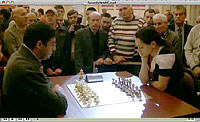
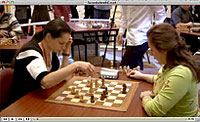
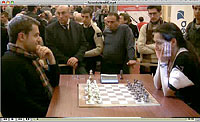
Screencrave.com has a very nice review of a chess film that is creating waves at the Sundance Film Festival 2013. Their reviewer has given the film 'Computer Chess' an 8/10 which is great for any chess film being showcased alongside films from several genres.

Christie Ko writes, "This film by writer/director Andrew Bujalski took me by surprise. I was expecting a relatively straight-forward reflection on a fictional, but realistic, 1980s computer science competition to develop a chess program that can beat a chess master. I was shocked and delighted to discover that Computer Chess is much more like a mockumentary, in the tradition of Best in Show, with a strange, sci-fi element reminiscent of Primer. This film is intelligent to its core, testing its limitations with brave camera work and a Lynch-worthy meta-narrative."
The Players:Writer/Director: Andrew Bujalski
Cinematographer: Matthias Grunsky
Production Designer: Michael Bricker
Starring: Patrick Riester, Myles Paige, James Curry, Robin Schwartz, Gerald Peary, Wiley Wiggins
Synopsis:The 1980 computer chess competition brings together the best and brightest computer programmers to pit their programs against each other in the hopes of developing a program capable of beating a human chess master. The eccentric competitors find themselves in awkward conversations and social situations that reveal their underlying similarities, as well as their essential differences of opinion about chess and life. Overlaid with an examination of technological innovation in the modern world, Bujalski’s film is funny, poignant, and forward-thinking.
Ko writes: This film is MY kind of weird. Its mixture of straight-faced humor and surrealist mini-vignettes manages to be both believable and fantastical. One thing that makes that possible is the look of the film, which takes a little getting used to. Shot using early PortoPak video techniques in [mostly] black and white and with an impeccably detail-oriented production, the work has a striking retro look that had me thinking it was found footage for the first five minutes. The combination of the aesthetic, the time period in which it is set, and the strangeness of the events manages a kind of equilibrium that wouldn’t have been possible had it been shot in high-def... Overall: This has been the best surprise I’ve had at Sundance so far; I walked in, was confused for a few minutes about what I was seeing, and then was positively swept away by the comedy and the strangeness that had me grinning from ear to ear, all the way through to the twisted ending."
As for us, we love chess movies. You watched Brooklyn Castle right? Check out all Chess Blog posts on Brooklyn Castle here.
Labels: chess film, chess movie, computer chess
'Computer Chess' Movie Wins Sloan Prize at Sundance Film Festival 2013
Chess blog for latest chess news and chess trivia (c) Alexandra Kosteniuk, 2012
Hi everyone,

Sundance Institute Programmers try to teach computers to play chess in Andrew Bujaski's "Computer Chess." The movie, playing in the Next program at the 2013 Sundance Film Festival, won Sundance's Alfred P. Sloan Prize.
A recent Chess Blog post told you about the movie 'Computer Chess' that was making waves at the Sundance Film Festival 2013. Now, we have more news: Andrew Bujalski's "Computer Chess," a black-and-white "existential comedy" about the guys who programmed the first chess-playing computer, has won the Alfred P. Sloan Feature Film Prize at the 2013 Sundance Film Festival, the Sundance Institute announced Thursday.
The prize, presented by the Alfred P. Sloan Foundation, goes to a film that explores science or technology as a theme or depicts a scientist, engineer or mathematician as a major character.
The Sloan Prize has something most other awards at Sundance don't have: Cash. The winner gets $20,000.
"Computer Chess" is playing in the Next program at Sundance.
From Alexandra Kosteniuk's
www.chessblog.com
Also see her personal blog at
www.chessqueen.com
Don't miss Chess Queen™
YouTube Channel

Labels: andrew bujalski, computer chess, Sundance Film Festival
FIDE Chess Motto: One Billion Clever People
Chess blog for latest chess news and chess trivia (c) Alexandra Kosteniuk, 2012
Hi everyone,
Fide president Kirsan Ilyumzhinov, in an interview to Olga Pshenitsyna of The Voice of Russia, says Fide is aiming for one billion people on the planet who play chess!
The 20th of July is celebrated as the International Day of Chess. This holiday has been initiated by the World Chess Federation. On this day, different themed events and competitions are being held under the auspices of FIDE. On this day, multy-board chess plays are held even in places of detention.
Of the 7 billion of the planet’s population, 600 million of them play chess. But Kirsan Ilyumzhinov, the President of the International Chess Federation (FIDE), believes that it is not enough. In an exclusive interview with the Voice of Russia he has told that he was planning to increase the number of chess players in the world to one billion in the next five years.
”I have set the task to increase the number of chess players in the world from 600 million to one billion people in the next five-six years. Our motto is “one billion clever people”. Why have I declared this idea? The reason for everything that is going on in the world right now – I mean wars, conflicts, financial and political crises – does not lie in the fact that there is not enough money, gold, oil or gas. And certainly not in the fact that people are so angry with each other. The reason is that the states and the systems are ruled by short-sighted people who have come into politics by accident. If we increase the number of chess players to one billion people, the critical mass will increase, too. For people belonging to this critical mass the probability of becoming members of Parliaments, mayors, ministers, presidents, and kings is much higher. And thus the number of future incorrect decisions will decrease”.
- Chess is being introduced into the school curriculum. What effect can it produce?
- In 1993 the President of Kalmykia introduced chess into schools on an optional basis. And after a year it was noticed that in those schools where children were taught to play chess, discipline and test results improved. I was five years old when I learned to play chess. Chess trains our brain and develops both the left and right hemispheres. It is no coincidence that world chess champion Mikhail Botvinnik used to say that chess was a synthesis of science, culture and sport.
- What is happening to chess in Russia?
- Chess is popular in Russia now, especially with children. When I introduced chess into the schools of Kalmykia, many of my colleagues - governors, and presidents of republics - supported this idea. In Moscow chess is developing as well. Recently I was invited to one of Moscow's kindergartens, where three-year-old children are learning to play chess. Children become more attentive. There is a principle in chess: first think, and then make a move.
- Do you know of such cases in history when politicians invited chess players to make some political decisions?
- I was 15 years old when I became the champion of Kalmykia in chess among adults. And I became a member of the Young Communist League City Committee. While in the army, I was the champion of the North Caucasus district, and our Party Committee used to invite me to participate in solving political issues. Janos Kadar, the head of Hungary, is a chess player. He was making decisions at the country level. Winston Churchill, the British Prime Minister, while interviewing somebody for a job in the government, was in the habit of asking: "Do you play chess, or not?" He knew that a chess player could calculate several moves ahead. Before signing a decree or adopting a law every politician must calculate how it is going to work, and how people are going to react to it. Therefore, it is desirable for politicians to train their brains, and play chess.
- In the past, chess players could only rely on their own brains while preparing for competitions, and now they can’t do without computers. Is there a threat that technology is going to supplant human brains?
- Scientists and science fiction writers have already written that one fine day a computer brain would seize power over mankind. We have already reached the level, when a program begins to make original moves. Why has a man used to beat a computer at chess? Because he used to make an unconventional move, and the computer was taken aback. Now computers begin to think unconventionally, and this is a progress. But when a man is playing with a man, he's not using a computer. In this case human brains are competing. But a person needs to develop. And his brain should develop, too.
Today a chess boom can be observed in many countries of the world. And programmes of developing and disseminating this ancient game are accepted at the state levels. Even in Mongolia, where chess has never been very popular, two international tournaments have already been held. Chess is taught in schools in Armenia, Azerbaijan, Turkey, and Latin American countries. At the beginning of every academic year, the President of Uruguay presents every first former with a mini-computer containing a chess program. In China children are taught to play chess in kindergartens from the age of five.
From Alexandra Kosteniuk's
www.chessblog.com
Also see her personal blog at
www.chessqueen.com Labels: Chess, FIDE, kirsan ilyumzhinov, the voice of russia
TCEC Computer Chess Championship New Season starts August 26th
Alexandra Kosteniuk's Chess Blog for Daily Chess News and Trivia (c) 2013
Hi everyone,

TCEC, the most renowned computer chess championship, starts its new season in September 2013 with improvements and a new live page. The new season of TCEC joins forces with Chessdom Arena, and together they hope to bring you unprecedented coverage and insights of high level computer chess.
The first TCEC Season concluded in May this year with Houdini winning the Superfinal against Stockfish with a score of 25-23, after multiple engines engaged in battles in the divisions. This time the hardware that will be available to the engines will be a powerful 16-core server that will ensure a strong foundation for the engines. This is a guarantee that the second Season of TCEC will be full of excitement and very high quality chess.
When does it start?
The official start of the TCEC season is August 26th, 2013. The games will be played one after the other, without any pause between the rounds, guaranteeing 24/7 top fun for the chess fans.
What is new?Starting this season, TCEC will be part of the Chessdom pages. The live games are going to be shown exclusively at the http://tcec.chessdom.com address, while several innovations will allow synergy with the Chessdom Arena.
Anton Mihailov, CEO of Chessdom, comments, “We are proud to have TCEC on the Chessdom pages. The best computer chess is coming this month and we will make sure to present the efforts, achievements, and intellectual challenges behind each of the participants in the new Season. In combination with the European Club Cup 2013and the World Chess Championship 2013, an exciting second half of the year is ahead with strong chess 24/7″
The TCEC director Martin Thoresen shares, “I am very proud and excited about the cooperation with Chessdom. I think that together, we will bring a lot of excitement to any chess-loving person out there”.
The TCEC participants
As usual, the tournament director of TCEC, Martin Thoresen, will carefully select the participants of this second Season. He will include the known top engines from previous seasons like Houdini (current TCEC Grand Champion), Stockfish and Komodo, as well as new aspirants in the lower divisions.
Read more »Labels: computer chess championship, Houdini, komodo, stockfish, tcec
First Official Advanced Chess Match in Ukraine ends in Thrilling Draw
Chess blog for latest chess news and chess trivia (c) Alexandra Kosteniuk, 2013
Hi everyone,

Women's world chess champion Anna Ushenina
Here's an interesting chess report from Ukraine. Kyiv’s Radisson Blu hotel hosted the nation’s first officially sanctioned advanced, or computer-assisted, chess match on April 2 between reigning women’s chess champion Anna Ushenina and women’s international master Olena Boytsun, according to a report by Kyivpost.com. The match ended in a 40-move draw after Boytsun, playing white, held the initiative for most of the game that put Ushenina uncomfortably on the defensive in a sharp position that originated in the Slavic Defense.
Both players “teamed up” with computer chess programs to play a high-quality game, virtually blunder-free. No player could look at their opponent’s computers, however. The idea is to use a chess program to help evaluate candidate moves during the course of the game, but the human player ultimately decides which move to make and is always in control.
“Advanced chess is the synthesis of creative chess play and latest computer technology,” said Kirsan Ilyumzhinov via video link, president of FIDE, the world’s chess governing body.
Advanced chess was first introduced after then world chess champion Garry Kasparov lost a chess match in 1997 to IMB’s Deep Blue computer program.
In 1998, he played the world’s first advanced chess match against Bulgarian grandmaster Veselin Topalov in Spain. Both used the ChessBase information search program combined with the Fritz-5 chess program, that ended in a 3-3 draw.
Rated 2477, Ushenina became Ukraine’s first women’s chess champion after winning the title in December 2012 in Russia. She overcame Bulgarian Antoaneta Stefanova in a tie-breaker.
She also was an integral part of Ukraine’s gold medal-winning national chess team, which took top honors in March at the World Women’s Chess Olympiad held in Kazakhstan.
Boytsun is rated 2264, and is a recognized economist and founder of the Chess for Children charity in Dnipropetrovsk.
From Alexandra Kosteniuk's
www.chessblog.com
Also see her personal blog at
www.chessqueen.com
Don't miss Chess Queen™
YouTube Channel
Labels: advanced chess, anna ushenina, olena boytsun
Interview with Chess Legends: Genna Sosonko on Elite Chess, Aging Process, World Champions
Chess blog for latest chess news and chess trivia (c) Alexandra Kosteniuk, 2012
Hi everyone,

Mikhail Botvinnik (seated) and Salo Flohr during their match in 1935, Moscow. Sosonko: "Chess in the 21st century has changed unimaginably, it has become a completely different game."
Photo credit: RIA Novosti, Shagin.
Elite chess and the aging
process: a conversation with Genna Sosonko
by David Kerans
If you take a peek at the table of contents of Genna Sosonko's latest book, The World Champions I Knew, you might think the title is a bit grandiose. For Sosonko devotes a significant amount of time to the legendary Capablanca and Alekhine, neither of whom he ever met. An attentive reader of the book, however, soon comes to conclude that the title is too modest.
In his successive portraits of the world champions Sosonko finds myriad ways to convey both well-known and lesser-known elements of chess culture as it developed over the twentieth century. A combination of oral history, anecdote, documents, photographs, and, wherever possible, his own personal recollections builds each portrait of a champion into a mosaic of a psyche and the world he experienced through chess. The result, I would wager, is the most memorable chess book you will ever read.
The World Champions I Knew makes no attempt at biography, nor chess analysis, nor psychoanalysis. Nowhere does Sosonko pretend to be complete in his coverage. Instead, he focuses on making these men as vivid as he can. In each case, he incorporates features of the time, the people, or the surroundings that oriented the man. In some cases he doesn't entirely establish what made them tick, but he always gives enough to feel that we know the man. And, importantly, the diversity of his subjects and his sources makes every chapter a fresh adventure. How many authors can claim that?
Beyond the world champions, and beyond the layer of grandmasters we meet along the way in The World Champions I Knew, we also get to meet Genna Sosonko, at least a bit. By this I mean not so much the moments when he participates in the narrative as much as the character of the narrative itself. Sosonko could not have made such a contribution to our images of the world champions without possessing a keen eye for detail, a knack for drawing out memories and reflections from many people, and, most important of all, a very unusual degree of empathy. Those who have read the chapter on Hein Donner in Smart Chip From St. Petersburg will have noticed how richly he portrayed Donner, and understood that such a portrait would not have been possible unless Sosonko had been engaged and perceptive in Donner's presence throughout their long acquaintance. Chess books don't teach you that...
Finally, a word to the wise here. New In Chess press has established a habit of underestimating the appeal of its titles, such that copies of some of their recent publications have escalated in value. (Donaldson on Rubinstein, van Perlo's Endgame Tactics, and Bareev's From London to Elista come immediately to mind). So get yourself a copy of The World Champions I Knew.You will not regret reading it, and might just turn a profit on it.
We had the opportunity to sit down with Grandmaster Sosonko when he came through Washington as an honored guest of a special tournament to honor the memory of Grandmaster Yurii Razuvaev. We put a number of questions to him concerning chess culture.
Kerans: Since Magnus Carlsen broke on the scene, if not earlier, most people have been convinced that chess players are getting younger. It hasn’t been hard to find explanations for that. Thus, the internet allows developing players to find opponents of their approximate class 24 hours a day, and tactics training sites feed you unlimited quantities of problems pitched to your skill level. Further, opening theory has expanded quickly and become easily accessible and searchable through databases. These explanations seem sufficient to me. And we can add the rapid advance of chess computers, of course. I have the impression that chess computers don’t do that much to develop young players, but I could be wrong. In any case, I assume chess computers help to develop some players, those with a certain frame of mind.
Meanwhile, in one of your recent articles I noticed an interesting quote on the transformation of chess and the ascendance of younger players, written all the way back in 1959, long before the computer revolution. It came from your friend, grandmaster Hein Donner. As you summarized it:
“…the Candidates Tournament of 1959 forced Donner to reverse his earlier opinion that Fischer would never become World Champion. ‘He is only 16 years old, Bobby Fischer from New York. And everyone has already accepted the fact that the wunderkind is at the same level as the strongest grandmasters in the world. And why not? These days, when energy and vigor play a larger role than knowledge and experience, chess is obviously getting younger.’”
Then, in you newest book, you say that in comparison to the time of Botvinnik, "Chess in the 21st century has changed unimaginably, it has become a completely different game." (p. 109).

Read more »Labels: chess professionals, david kerans, genna sosonko, irina levitina, mikhail botvinnik, the voice of russia
Rybka disqualified and banned from World Computer Chess Championships
Chess blog for latest chess news and chess trivia (c) Alexandra Kosteniuk, 2011
Hello everyone,
News that will surely rock the chess world - Rybka disqualified and banned from World Computer Chess Championships.
www.chessvibes.com has just carried a detailed article on the episode. The International Computer Games Association (ICGA) has disqualified and banned Rybka and its programmer Vasik Rajlich from previous and future World Computer Chess Championships. The ICGA accuses Rajlich of plagiarizing two other programs, Crafty and Fruit, and demands that he returns the trophies and prize money of the World Computer Chess Championships in 2007, 2008, 2009 and 2010.
www.chessvibes.com further states: The news is obviously a huge blow for the Rybka team. The impact in the computer chess world must be comparable to arguably the most famous example of doping in athletics: the positive drug testing of Canadian sprinter Ben Johnson in 1988. We’ve asked Vasik Rajlich for a comment and hope to add this later.
Go on read the full article.
From Alexandra Kosteniuk's
www.chessblog.com
Also see her personal blog at
www.chessqueen.com Labels: disqualified, Rybka
Cool chess article about how computers win chess
Chess blog for latest chess news and chess trivia (c) Alexandra Kosteniuk, 2011
Chess fans watch as computer program Deep Blue defeats then-world chess champion Garry Kasparov in May 1997.
Photo: Reuters
Here is a very nice story about computers and chess. It explores the concept of how computers tackle chess. You will enjoy reading it.
Chess is one of humanity's most cerebral activities and devising a machine that could beat us at our own game was a long-standing goal of artificial intelligence.
This goal is generally acknowledged to have been reached in 1997 when IBM's Deep Blue defeated grandmaster and world champion Garry Kasparov. But there is more to the legacy of computer chess than that triumph.
Chess is one of humanity's most cerebral activities and devising a machine that could beat us at our own game was a long-standing goal of artificial intelligence.
The first machine to play chess was unveiled by Wolfgang von Kempelen in 1770. It took the form of a man in Eastern garb sitting behind a box on top of which was a chess board. The Turk, as it came to be known, appeared to play its human opponents using nothing but clockwork and toured the world, becoming famous.
But it was all an illusion. A cunningly concealed human operator directed the action on the board, moving the Turk's arm using a system of levers and reading the opponent's moves via magnets.
The Turk did leave us with more than a good story, though, for it is believed to have helped inspire the development of genuine breakthroughs from the power loom to the telephone.
For a machine that could really play chess the world had to wait for the computer age. Computing heavyweights like Alan Turing were obsessed with chess even before computers were powerful enough to play it. Chess has simple, well-defined rules but is also difficult to play well so it was seen as a good test for the fledgling field of artificial intelligence.
The key to success in chess is to look ahead at the consequences of different moves and counter-moves. The problem is that there are a lot of possibilities to examine. For each board position in chess there are on average 35 possible moves that can be made, for each of those an average of 35 counter-moves and so on.
One way to look ahead further is through software tricks that stop the computer going down blind alleys as it considers future moves. Another is fast, specialised hardware. Deep Blue used both when it beat Kasparov in 1997.
Deep Blue could play a mean game of chess – but that is all it could do.
On the other hand it showed that in just 50 years we could go from a standing start to creating a chess-playing machine that outstripped even our best and brightest.
So what's our next move?
From Alexandra Kosteniuk's
Also see her personal blog at
Labels: chess and computers
World's 1st Computer Chess Unit to Appear at NUIG Digital Games Event
Chess blog for latest chess news and chess trivia (c) Alexandra Kosteniuk, 2013Hello everyone,

This interesting chess news comes from Ireland. Kernan Andrews, writing in the Galway Advertiser, states the world’s first computer chess unit will make an appearance at NUI Galway’s Coding Computer Games – Past, Present & the Future event on Saturday March 2. The event runs from 12 noon to 2pm in the Digital Enterprise Research Institute, IDA/NUIG Business Park Dangan.
The Fidelity Chess Challenger was the first chess electronic unit available to the public. Based on a Z80 8-bit micro-processor, it started production in 1977 with its most popular model, the Fidelity Chess Challenger 7, selling some 600,000 units. Its inventor Sidney Samole got the idea for computer chess after watching an episode of Star Trek.
Also at the event, Galway-based software developers such as Tribal City and Starcave Entertainment will demonstrate some of their latest web-based games. Children from the local Coderdojo club will introduce visitors to the coding behind their own games.
There will also be classic arcade games like Asteroids, Pacman, Sonic, and Pong played on vintage consoles and computers such as Atari, Amiga, and Sinclair ZX81.
The event is a collaboration of Coderdojo Galway, the Computer and Communications Museum of Ireland, and the Digital Enterprise Research Institute at NUI Galway, and is part of National Engineers Week.
From Alexandra Kosteniuk's
www.chessblog.com
Also see her personal blog at
www.chessqueen.com
Don't miss Chess Queen™
YouTube Channel

Labels: chess computer
A chess star emerges for the post-computer age!
Chess blog for latest chess news and chess trivia (c) Alexandra Kosteniuk, 2011
Hi everyone,
Here is a sweet interview with Magnus Carlsen in the New Yorker. Though, you would need a subscription to read the full article. Here is an excerpt:
PROFILES - THE PRINCE’S GAMBIT
A chess star emerges for the post-computer age.
by D. T. Max
MARCH 21, 2011
Read the full text of this article in the digital edition (subscription required), or on iPad app.
 ABSTRACT: PROFILE of Norwegian chess star Magnus Carlsen. Writer describes a match between Carlsen and Vladimir Kramnik at the London Chess Classic in December. In the match, Carlsen had recovered from a situation that the Russian champion Garry Kasparov called “impossible” to force a draw. Carlsen, who had just turned twenty two weeks earlier, is largely self-taught, and can play various styles of chess. He has been a full-time chess player since he was fifteen, and spends more than a hundred and sixty days a year on the road. When he is not travelling, he lives in a house with his family in an affluent suburb of Oslo. Carlsen left school two years ago without formally graduating. Tells about Magnus Carlsen Against the World, an event staged by Carlsen’s sponsor G-Star at New York Fashion Week. Carlsen played against a team of three grandmasters. Many people in the chess world considered the contest vulgar. At the trophy presentation, Liv Tyler, another G-Star endorser, gave Carlsen a silver plaque. Most grandmasters start chess extremely young, but Carlsen did not, though he had shown unusual mathematical aptitude as a little boy, which is often found in chess talents. He was more engaged by soccer and skiing. When Magnus was eight, his father made another attempt to engage him in chess and this time, he recalled, he found it “just a richer and more complicated game than any other.” Tells about Carlsen’s development as a chess player. He has a prodigious memory for board positions and moves. He studied with Simen Agdestein, a top Norwegian grandmaster at the time, and later with Kasparov. Briefly discusses the history of chess, which was brought to the West by way of Persia sometime between the eighth and tenth centuries. Describes the approach to the game developed by the Soviets and also tells about the development of computer chess programs. Mentions Kasparov’s loss to the I.B.M. mainframe Big Blue, in 1997. Carlsen said that for him, great chess playing is less the “scientific search for the best approaches” than “psychological warfare with some little tricks.” Describes Carlsen’s performance in the 2011 Wijk aan Zee tournament in Holland, where he lost his confidence. He told the writer, “Suddenly, I started to get these doubts. All of a sudden, my fighting spirit was almost gone.” Carlsen was already thinking ahead to the Amber chess tournament, which is being played this month, in Monaco. The games there do not affect anyone’s official ranking, since the participants play either rapid or blindfold chess; all the same, he said, “I really, really want to win and restore the power balance.” ABSTRACT: PROFILE of Norwegian chess star Magnus Carlsen. Writer describes a match between Carlsen and Vladimir Kramnik at the London Chess Classic in December. In the match, Carlsen had recovered from a situation that the Russian champion Garry Kasparov called “impossible” to force a draw. Carlsen, who had just turned twenty two weeks earlier, is largely self-taught, and can play various styles of chess. He has been a full-time chess player since he was fifteen, and spends more than a hundred and sixty days a year on the road. When he is not travelling, he lives in a house with his family in an affluent suburb of Oslo. Carlsen left school two years ago without formally graduating. Tells about Magnus Carlsen Against the World, an event staged by Carlsen’s sponsor G-Star at New York Fashion Week. Carlsen played against a team of three grandmasters. Many people in the chess world considered the contest vulgar. At the trophy presentation, Liv Tyler, another G-Star endorser, gave Carlsen a silver plaque. Most grandmasters start chess extremely young, but Carlsen did not, though he had shown unusual mathematical aptitude as a little boy, which is often found in chess talents. He was more engaged by soccer and skiing. When Magnus was eight, his father made another attempt to engage him in chess and this time, he recalled, he found it “just a richer and more complicated game than any other.” Tells about Carlsen’s development as a chess player. He has a prodigious memory for board positions and moves. He studied with Simen Agdestein, a top Norwegian grandmaster at the time, and later with Kasparov. Briefly discusses the history of chess, which was brought to the West by way of Persia sometime between the eighth and tenth centuries. Describes the approach to the game developed by the Soviets and also tells about the development of computer chess programs. Mentions Kasparov’s loss to the I.B.M. mainframe Big Blue, in 1997. Carlsen said that for him, great chess playing is less the “scientific search for the best approaches” than “psychological warfare with some little tricks.” Describes Carlsen’s performance in the 2011 Wijk aan Zee tournament in Holland, where he lost his confidence. He told the writer, “Suddenly, I started to get these doubts. All of a sudden, my fighting spirit was almost gone.” Carlsen was already thinking ahead to the Amber chess tournament, which is being played this month, in Monaco. The games there do not affect anyone’s official ranking, since the participants play either rapid or blindfold chess; all the same, he said, “I really, really want to win and restore the power balance.”
You can also read a nice post on this article here by Richard Brody.
From Alexandra Kosteniuk's
www.chessblog.com
Also see her personal blog at
www.chessqueen.com
Labels: chess blog, Magnus Carlsen
Casting Call for Austin, Texas Feature Film 'Computer Chess'!
Chess blog for latest chess news and chess trivia (c) Alexandra Kosteniuk, 2011
Hi everyone,
We just found this very interesting press information: Casting Call for Casting Call for Austin, Texas Feature Film 'Computer Chess'!
Production Title: ‘Computer Chess’
Studio/Independent/Student: Independent
Union/Non-Union: Non-Union
Project Type: Feature Film
Production Location: Austin, Texas
Production Start Date: August 20, 2011
Production Wrap Date: September 04, 2011
Synopsis: The film takes place in 1979/1980 at a hotel in the Southwest and revolves around a computer chess tournament during which participants (university and corporate teams) set their computer programs against each other to see which can maneuver the chessboard most effectively.
Character Breakdowns:
Extras come out according to their availability (there’s no requirement for # of days,etc)
Paid/Non-Paid: Non-Paid
Meals/Lodging/Transportation Provided: Meals, Snacks and Beverages
*Email Your Casting Submissions To: ComputerChessMovie@gmail.com
From Alexandra Kosteniuk's
Also see her personal blog at
Houdini elbows past Rybka to win computer chess challenge
Chess blog for latest news and trivia (c) Alexandra Kosteniuk, 2011
Hi everybody,Have you ever sat across an opponent before a chess game and wondered what machine he used at home to prepare against you? When someone mentions chips you think not of coffee and tea-time but a computer chess program?Speak to any chess player and they would name top chess players like Vishy Anand, Magnus Carlsen, Vassily Ivanchuk, Rybka and Houdini in the same breath. Human or machine? It's the strong chess that counts in the end. No wonder then, we kept track of the recent-ly concluded Thoresen Computer Engines Competition. Houdini, a free program, managed to elbow past Rybka - the winner of four computer world chess championships.The competition was a double round-robin, and it used the Bilbao Scoring System in which each win counts as 3 points and each draw as 1. Houdini finished with 24 points and Rybka with 23.Stockfish, another free program, finished third, with 20 points, while Ivanhoe and Critter, yet another free program, tied for fourth and fifth, with 17 points each, though Ivanhoe was fourth on a tie-breaker. Rounding out the field were Shredder and Naum, which each scored 12 points, and Hiarcs, which ended with 11.What makes the contest even more interesting for us flesh-and-blood chess players is that the chips-and-circuits players had different playing styles as well - depending upon how they have been designed and programmed. Definitely these 'guys' are better than humans but not perfect at chess. Chess has not been 'solved' yet. What a relief and we feel smug about it somewhat. You can find some interesting articles and comments at this link of the website that organized the tournament.Labels: chess blog, computer chess, Houdini, Rybka
Cheating in Chess: Another Player Brings Bad Reputation to Chess
Alexandra Kosteniuk's Chess Blog for Daily Chess News and Trivia (c) 2013Hi everyone,

DYLAN LOEB McCLAIN writes about (in The New York Times) German Jens Kotainy, a German international master, who was disqualified at the Sparkassen Chess Meeting’s open section before the last round this month after tournament officials questioned how he was using his cellphone. We also witnessed high security at the ongoing World Chess Cup 2013 being played in Tromso, Norway. Unfortunately, it appears, cheating in chess is here to stay and we just need to get more alert to people trying to spoil the sport.
Kotainy had been the top seed at Sparkassen, held in Dortmund, Germany, and had easily won his first seven games, including one against the Grandmaster Eckhard Schmittdiel, before he was disqualified. The tournament’s director, Christian Goldschmidt, said in a note posted online that when he asked to see the cellphone, Kotainy pulled it out of his pocket and said it was turned off, as required by the rules. But Goldschmidt said that while he was holding it, the phone started giving off vibrations that resembled Morse code, writes McClain.
Kotainy has been quoted on several websites as saying that the vibrations were part of an anti-theft application installed by his brother, a computer programmer. Goldschmidt did not believe him, writing that Kotainy had reached into his pocket after every move, writes McClain.
"Goldschmidt had been suspicious of Kotainy because several experts — including Kenneth W. Regan, a computer science professor in Buffalo who is working on a program to detect cheating — found that Kotainy’s moves had matched the choices of a leading computer program almost exactly. Regan said he had found the same pattern in Kotainy’s games during his previous two tournaments.
"Regan, a member of a new anticheating commission at the World Chess Federation, wrote in an e-mail to other panel members that the odds were a billion to one that Kotainy’s moves would match the computer program’s over the three tournaments.
McCLAIN says, "What happens now is unclear. The anticheating commission will hold its first meeting in Tallinn, Estonia, this year, and the question of what is sufficient proof of cheating is on the agenda, as is what is the appropriate punishment. Kotainy could be disciplined by the German Chess Federation, though it has no clear policy on cheating."
McClain's column further discusses one of the games played at the event. The problem is as security at chess tournaments increases, so will players find more ways to cheat and bypass that security. This is developing into a cat-n-mouse game. It is upon chess players to take a pledge not to cheat - no matter what the incentive - and to encourage their friends as well. A boycott of cheaters is necessary as well to save the sublime support of chess.
Chess Blog has, from time to time, written about anti-cheating measures. In November, last year, the Fide Trainers' Committee accepted GM Konstantin Landa's complete proposal for anti-cheating measures. GM Konstantin Landa, Elo 2640, is a senior FIDE trainer, and long-time coach of Chess Queen Alexandra Kosteniuk and Arkadij Naiditsch. You can read details of GM Landa's proposal at this Chess Blog link. Feel free to send us any ideas you have to check cheating in chess.
Labels: arkadij naiditsch, chess and cheating, konstantin landa
The Chess Scene in Movies: All the Different Meanings!
Chess blog for latest chess news and chess trivia (c) Alexandra Kosteniuk, 2013Hi everyone,
Here's a truly neat chess feature from denofgeek on how chess has been used as a motif to mean so many different things in the movies. In fact, the 'symbolism' of chess has evolved in art, literature and cinema. Chess is both sexy and geeky nowadays - it depends. Read on:
A symbol of cunning, intelligence and death, the movie meanings of chess are as varied as the actors who've played it, Aliya writes...
You may not know much about shorthand typing, but if you’re a movie fan then you’re a trained professional in reading the dots and squiggles of the screen. Writers and directors use our preconceptions from watching thousands of hours of movies in order to make a more satisfying viewing experience. It’s a kind of shorthand, and it gives us a lot of information. Unfortunately, it can also take the place of decent acting, scene-setting and characterisation. But hey, that’s what we get for being so darned clever at this reading film stuff.
The game of chess has a long history, dating back to the sixth century AD, so it was already well-established in our collective psyche by the time movies came along and started to make use of it. Since the silent era, films have used chess as code for a number of character traits. Here’s a list of the classic ones:
I’m smart and I might be an evil robot

Building on its established reputation of being a game for the elite, chess made one of its first movie appearances in an adaptation of a true story involving the global hoodwinking of the aristocracy.
Raymond Bernard’s 1927 silent film, The Chess Player, tells the story of an inventor who creates an automaton that conceals a Polish nobleman. It’s not far from reality – at the end of the eighteenth century a famous automaton called The Turk travelled the world and won a number of chess matches against the rich and famous, including Napoleon and Benjamin Franklin. In fact, The Turk was not an automaton at all, but a machine that could be operated by numerous chess masters. This part of the story didn’t make it into the movie version.
Still, to come up with the idea of making a false chess automaton and then getting nobility all over the world to buy it just goes to prove how clever that inventor was, making him the perfect subject for the first ‘I’m smarter than you’ chess movie. It was good enough to spawn a remake in 1938 with Conrad Veidt as the inventor.
From there, chess was established as easy shorthand for being deeply brainy. If you’re a clever character, you have a chess set in your house somewhere, whether you get to play it or not. For instance, in Cape Fear (1962) Gregory Peck has a chess set in his office. In Dante’s Peak (1997) Pierce Brosnan has a chess set on his coffee table. Basically, if you were a professional doctor, lawyer or volcanologist, you had a chess set.
Perhaps the most interesting offshoot of the brainy chess player trope is its connection with artificial intelligence, and the threat that it is perceived as representing. In Blade Runner (1982) JF Sebastian and Tyrell play a game of chess via videophone. When Sebastian comes up with some killer moves, Tyrell invites him over to his penthouse – unfortunately the moves were provided by the android creation of the Tyrell corporation, Roy Batty (Rutger Hauer) who wants answers. Here the creation has out-thought the creator. The moves were based on a real chess game, played between Anderssen and Kieseritzky in an 1851 tournament in London and known as ‘the Immortal game’: Blade Runner is a film with an amazing number of layered meanings throughout.
Yes, computers love to play chess. In WarGames (1983) chess is one of the options available to Matthew Broderick’s character when trying to stop super-computer Joshua from instigating global thermonuclear war. Thank goodness they decided to play noughts and crosses instead. But perhaps the smartest of them all is Hal 9000, who wins against astronaut Dr Frank Poole (Gary Lockwood) in Kubrick’s monumental 2001: A Space Odyssey. Hal even points out where Poole is going wrong, being a helpful sort of computer. In fact, Hal cheats during the match. But since Kubrick was a great chess player, we have to assume that Hal’s cheating is not a movie mistake but proof that Hal is so much smarter than Poole that he can smugly declare a win without having to go to the trouble of actually winning, and Poole will accept his judgement. Now that’s clever.
I’m sexy
In 1968, Thomas Crown made chess sexy. It was quite an accomplishment, as traditionally chess was seen as a purely male pursuit. It was objective, and rational, and about the mind, not the body. But suddenly smart and sexy came together for movie women, and Faye Dunaway was able to portray what would have traditionally been a male character – the investigator hot on the trail of the criminal. Read more »Labels: chess in cinema, chess scene
Chess is Like Life, says Asia's 1st GM Eugene Torre
Chess blog for latest chess news and chess trivia (c) Alexandra Kosteniuk, 2012
Hi everyone,
We have a very nice interview with GM Eugene Torre taken on the sidelines of the recently-concluded Indonesia Chess Open.
The name of Eugenio Torre is irrevocably linked with that of Asian and World chess. Torre, who is now 60 years of age, is the first Asian to achieve the title of grandmaster. He is also the holder of the record for participating in the most number of World Chess Olympiads with his surprise qualification for his national team and subsequent excellent performance at the World Chess Olympiad 2012.
The Filipino legend who is still an active player and participating at the Indonesia Open Chess Championship (IOCC) 2012 is very positive indeed about the outlook for chess in Asia. Eugenio Torre shares in an interview by Peter Long for Chessdom.com his views on the IOCC, hopes for chess in Asia and for his beloved Philippines.
Q: How are you finding Indonesia Open Chess Championship?
A: Very good – well organized and with all the conveniences. Many strong players are participating. Last year I also played in IOCC 2011 which was the first edition. Now I am here again and it is even better. All this because Indonesia has given very good support to chess and so I am confident that IOCC will continue to be held for a third, fourth time and thereafter.
Indonesia is a developing nation in Asia that values and honors chess. I also know that Indonesia sees chess as a way to combat illegal drug usage among students and in society.
Q: Given your vast experience in chess do you have any suggestions for us to improve IOCC?
A: I do have some suggestions for the organisers. For the next IOCC maybe you can make it a one day blitz tournament. Because many strong chess players that have come are from all corners of the globe and such an event will be good encouragement for locals to play blitz. Also blitz now is rated. The current prize fund is very good. It will not be a problem to reduce slightly and expand the prize fund further to perhaps 50. It is not the amount, but a chance for local players to win something. There has been a lot spent on organizing and the savings would be considerable so small amount prizes but they got the happiness of the game.

Read more »Labels: eugene torre, peter long
Chess Queen Kosteniuk Top 10 Chess Tips

The Top 10 Blog posted today the Top 10 Chess Tips by Alexandra Kosteniuk.
If you would like to suggest different top 10 chess tips, you can do it either in the comments to this post, or on Alexandra's personal chess blog at this link: http://chessqueen.com/?p=1790.
Link to the original article on Top 10 Blog:
Chess Queen's Top 10 Chess Tips
1. Play Chess with a human, not a computer!
The goal of playing chess is to have fun, and you definitely will not have fun playing a computer, even if you set the level to be a very low one. You want your opponent to suffer, to wonder about your intentions, to be caught by your traps. Chess is a battle of the minds. You can only do that with a human. For me, chess is only a game to be played between 2 humans.
[note: you can play chess with a human on the internet on any of the many available chess servers]
2. Play chess not only to have fun, but to get better (and to win!)
Each time you play chess, besides trying to win, you have the chance to learn something. And you learn by making mistakes. So don’t be afraid of losing, that will be a very valuable lesson and you will win many more games in the future thanks to what you have learned from your mistakes. With chess you will learn your whole life!
2b. Try to play someone a little better than you
Playing someone much weaker is pretty much a waste of time, but playing someone a little stronger than you is best! You should have an outside chance of winning, so if you win you’ll be proud of your result, and if you lose you will learn a lesson, that’s a win-win proposition!
3. Believe in yourself and you can beat anyone!
Never be impressed by someone’s chess “resume”. A chess game starts at equality, so you have as much chance as your opponent to win. Especially if you have prepared a little for the game and are in a fighting spirit.
3b. Believing in yourself does not mean it's easy to win.
Never be sure of winning! A game is never won before your opponent has resigned. The hardest thing to do is to win a won game. So be very careful to the very end!
4. Don't study individual openings. Study chess opening principles.
I did not get into detailed opening study until I became Grandmaster. It’s enough to know the top opening principles, such as control the center, develop knights before bishops, castle as soon as possible, don’t take out your Queen too early, make all your pieces take part in the battle . You might have fun memorizing the longest line of your favorite opening but it won’t help you if your opponent deviates and plays something else
5. The best way to improve at chess is to study Chess Tactics.
Chess games are won in the middle game, so studying tactics will be most beneficial. It’s also easy to do, either with a tactics book, or with software from www.chesskingtraining.com . The more you train on tactics, the better your practical results in chess will be.
6. Exception to the previous Top 10 Rule: Don't neglect studying chess endgames.
Even though you will rarely get to the endgame when you start playing chess, it is critical to have fundamental knowledge in that area! Beginners will benefit from learning how to mate with 2 rooks, with a queen, with a rook, with 2 bishops, intermediate players need to know how to win (or to draw) with 1 pawn (or one pawn down), or with bishop and knight against king, and experienced players will win critical points in tournaments thanks to a good grasp of the endgame.
7. Just before playing, make a last review
If you are sure of what you want to play, don’t play it yet. Make sure it’s not a blunder, and that all your pieces are safe. Also, you’re trying to make the best move, so even if you have found a good move, maybe there is a better one out there, so be on the lookout.
8. Have a plan, look at your opponent's move.
When your opponent makes a moves, try to figure out his/her plan and his/her intentions. Are there any pieces attacked? Is he/she targeting an important outpost? Only once you know what your opponent is up to will you be able to defend well and at the same time prepare your own plan and attacks. Don’t make any move that does not have a specific goal or target.
9. Don't play too fast, take your time.
You won’t get a prize for playing super fast, on the contrary, playing too fast will make you lose valuable points since you’ll make mistakes. A good rule is to use almost all the time you are given on the clock.
10. Play blitz chess, not bullet chess.
Playing blitz chess (5 minutes per game per player) is both fun and useful (as long as you keep record of the moves or at least note which opening you played, so you can review the moves later). However, don’t play bullet chess (1 or 2 minutes per game per player), since the goal of bullet chess is no longer to play the best moves, but the fastest moves. And never play more than 10 games in a row, as it becomes either impossible to remember them all, or too much work to go over the games later on, and it simply becomes a repetition of the same mistakes.
Labels: Chess Queen Alexandra Kosteniuk, tips
Special interview: The charm of correspondence chess
Chess blog for latest chess news and chess trivia (c) Alexandra Kosteniuk, 2011
Hello everyone,
This was a neat chess interview we found of Wayne Pressnall, 76, of North Platte, who is the highest-rated postal chess player in Nebraska, having achieved a master's rating in the USCF! He began playing chess at age 17 when he was a projectionist at the local movie theater in Wymore and needed to pass time between changeovers.

He won a couple of college championships but he found little competition when he started his teaching career in 1959 at Fullerton. "With nothing much else to do there, I found a copy of Chess Review on a newsstand somewhere and found that I could enter a postal tournament."
He entered a Class B tourney and won a section, helped by an opponent who sent his first move for game and an "If" move for game two, playing g6 and Bg7 to any two moves by Wayne.
"I learned then and there that there is no way to forgive an opponent anything at postal chess. There are no take backs or give backs in the rules."
He said he learned about the dark side to postal chess: players who, behind in their position, would just stop sending moves or resignations. Some would sign up for games and never make a move.

"But the most frustrating thing was that the postal director hated to forfeit anybody for gross lateness. With these annoyances, I thought of quitting postal chess several times."
He adds the games were fun and the correspondence between players was also fun. He quit postal chess for a while when he received an NSF fellowship at the University of Pennsylvania where he earned his M.S. His wife, Gloria, also delivered their second child.
"I decided the busy life was not conducive to postal chess. So I quit."
 By 1967, he had taught three years at Peru St. College Campus H.S. He was also helping raise their two children, Gretchen and Will. He read in a paper that the Campus School would be closed so he landed a position teaching physics, chemistry, and sometimes freshman science and algebra at Schuyler. He took up postal chess again.
He was inspired to play over the board (OTB) chess reading Chess Review, which mentioned the Midwest Open in Lincoln.
"I thought on the basis of my experiences so far, that I would just go down and win the $100 first prize. I was 32 then. One Bud Narveson showed me the error in my thinking in the very first round." He did go 3-2 and won the unrated trophy and received a class B rating. It was then he discovered the difference between correspondence and OTB chess.
"In postal, one can be analytical and try out one's ideas before sending a move. In OTB, to try something is to make blunders and I was very prone to that. In fact, I believe that one out of every 40 OTB moves I made was a blunder." He won the OTB state championship in 1995. He stopped playing OTB about 1998. He saw his rating plunge from 2025 to a floor of 1800.
"My main talent had become falling asleep during the games." His best postal finish was in the 1978 Golden Knights where he finished a couple of points behind the winner, raising his rating to 16th in the country.
He said he has about 20 games going at any one time. "The hardest part of keeping up with them is the amount of traveling Gloria and I do."
He said he averages less that two days reflection time while the rules permit three days. "I don't have as much problem with falling asleep during planning a move. I can wake up and not have to move while groggy. So CC is for my present condition as a 76-year-old with conditions."
He said he struggles with notation errors mostly now. "I have lost my master's rating and failed to place well in the Golden Knights just on notation errors."
He said a computer database that he bought to record moves is helping some. But the compter is also making the game tougher.
"Nobody makes simple errors anymore. I suspect that this has something to do with the various chess playing engines out there. But there is no way to know that. Many players will admit having an opening database, but few will tell how else they use their computers. A few would like to change your CC game over to a computer game, but I always refuse. The computer games always seem to put pressure on one to move at a faster pace than my schedule permits and I always have projects that tie up my computer anyway. So normally I play only by postcard."
Among his funny experiences in CC was the time a lower-rated player caught him making a hasty move before Wayne left town on a trip, resulting in Wayne being a piece down.
"I decided to make another move anyway and my game improved and kept on improving move by move until it was drawn and then it was won. It turned out he had played the game without his extra piece on his record board."
It's all part of the wonderful game of chess.
"CC can take some strange turns like OTB and as it is chess it is still interesting and often fun."
By 1967, he had taught three years at Peru St. College Campus H.S. He was also helping raise their two children, Gretchen and Will. He read in a paper that the Campus School would be closed so he landed a position teaching physics, chemistry, and sometimes freshman science and algebra at Schuyler. He took up postal chess again.
He was inspired to play over the board (OTB) chess reading Chess Review, which mentioned the Midwest Open in Lincoln.
"I thought on the basis of my experiences so far, that I would just go down and win the $100 first prize. I was 32 then. One Bud Narveson showed me the error in my thinking in the very first round." He did go 3-2 and won the unrated trophy and received a class B rating. It was then he discovered the difference between correspondence and OTB chess.
"In postal, one can be analytical and try out one's ideas before sending a move. In OTB, to try something is to make blunders and I was very prone to that. In fact, I believe that one out of every 40 OTB moves I made was a blunder." He won the OTB state championship in 1995. He stopped playing OTB about 1998. He saw his rating plunge from 2025 to a floor of 1800.
"My main talent had become falling asleep during the games." His best postal finish was in the 1978 Golden Knights where he finished a couple of points behind the winner, raising his rating to 16th in the country.
He said he has about 20 games going at any one time. "The hardest part of keeping up with them is the amount of traveling Gloria and I do."
He said he averages less that two days reflection time while the rules permit three days. "I don't have as much problem with falling asleep during planning a move. I can wake up and not have to move while groggy. So CC is for my present condition as a 76-year-old with conditions."
He said he struggles with notation errors mostly now. "I have lost my master's rating and failed to place well in the Golden Knights just on notation errors."
He said a computer database that he bought to record moves is helping some. But the compter is also making the game tougher.
"Nobody makes simple errors anymore. I suspect that this has something to do with the various chess playing engines out there. But there is no way to know that. Many players will admit having an opening database, but few will tell how else they use their computers. A few would like to change your CC game over to a computer game, but I always refuse. The computer games always seem to put pressure on one to move at a faster pace than my schedule permits and I always have projects that tie up my computer anyway. So normally I play only by postcard."
Among his funny experiences in CC was the time a lower-rated player caught him making a hasty move before Wayne left town on a trip, resulting in Wayne being a piece down.
"I decided to make another move anyway and my game improved and kept on improving move by move until it was drawn and then it was won. It turned out he had played the game without his extra piece on his record board."
It's all part of the wonderful game of chess.
"CC can take some strange turns like OTB and as it is chess it is still interesting and often fun."
From Alexandra Kosteniuk's Also see her personal blog at Labels: correspondence chess
Creator of Belle chess playing machine dies at 76
Chess blog for latest chess news and chess trivia (c) Alexandra Kosteniuk, 2012Hi everyone,Joseph Henry Condon, an experimental physicist and engineer, died on January 2 at the age of 76. He, in partnership with Ken Thompson, created Belle, a pioneering combination of computer and special hardware that played championship quality chess.

One of the major collaboration between Joe and Ken Thompson was the creation of the chess-playing machine named Belle. Joe designed custom hardware while Ken designed the software. The hardware evaluated board position, did piece move generation, and used a cache memory for previously evaluated board positions. Belle’s hardware could evaluate millions of board positions and generate all legal chess moves every second. The control software kept track of how many moves ahead the hardware was evaluating and selected the best current move. Belle was very compact and easily portable and was taken to many chess tournaments where it achieved a master rating. Belle won the world computer chess championship in 1980 and the U.S. computer chess championships in 1978, 1980, 1981, 1982, and 1986.
From Alexandra Kosteniuk's
www.chessblog.com
Also see her personal blog at
www.chessqueen.com
Labels: belle, chess computer, Joseph Henry Condon, obituary
|
|