
Interview with Chess Legends: Genna Sosonko on Elite Chess, Aging Process, World Champions
Chess blog for latest chess news and chess trivia (c) Alexandra Kosteniuk, 2012
Hi everyone,

Read more »Hi everyone,
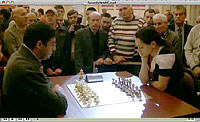
Mikhail Botvinnik (seated) and Salo Flohr during their match in 1935, Moscow. Sosonko: "Chess in the 21st century has changed unimaginably, it has become a completely different game."
Photo credit: RIA Novosti, Shagin.
by David Kerans
If you take a peek at the table of contents of Genna Sosonko's latest book, The World Champions I Knew, you might think the title is a bit grandiose. For Sosonko devotes a significant amount of time to the legendary Capablanca and Alekhine, neither of whom he ever met. An attentive reader of the book, however, soon comes to conclude that the title is too modest.
In his successive portraits of the world champions Sosonko finds myriad ways to convey both well-known and lesser-known elements of chess culture as it developed over the twentieth century. A combination of oral history, anecdote, documents, photographs, and, wherever possible, his own personal recollections builds each portrait of a champion into a mosaic of a psyche and the world he experienced through chess. The result, I would wager, is the most memorable chess book you will ever read.
The World Champions I Knew makes no attempt at biography, nor chess analysis, nor psychoanalysis. Nowhere does Sosonko pretend to be complete in his coverage. Instead, he focuses on making these men as vivid as he can. In each case, he incorporates features of the time, the people, or the surroundings that oriented the man. In some cases he doesn't entirely establish what made them tick, but he always gives enough to feel that we know the man. And, importantly, the diversity of his subjects and his sources makes every chapter a fresh adventure. How many authors can claim that?
Beyond the world champions, and beyond the layer of grandmasters we meet along the way in The World Champions I Knew, we also get to meet Genna Sosonko, at least a bit. By this I mean not so much the moments when he participates in the narrative as much as the character of the narrative itself. Sosonko could not have made such a contribution to our images of the world champions without possessing a keen eye for detail, a knack for drawing out memories and reflections from many people, and, most important of all, a very unusual degree of empathy. Those who have read the chapter on Hein Donner in Smart Chip From St. Petersburg will have noticed how richly he portrayed Donner, and understood that such a portrait would not have been possible unless Sosonko had been engaged and perceptive in Donner's presence throughout their long acquaintance. Chess books don't teach you that...
Finally, a word to the wise here. New In Chess press has established a habit of underestimating the appeal of its titles, such that copies of some of their recent publications have escalated in value. (Donaldson on Rubinstein, van Perlo's Endgame Tactics, and Bareev's From London to Elista come immediately to mind). So get yourself a copy of The World Champions I Knew.You will not regret reading it, and might just turn a profit on it.
We had the opportunity to sit down with Grandmaster Sosonko when he came through Washington as an honored guest of a special tournament to honor the memory of Grandmaster Yurii Razuvaev. We put a number of questions to him concerning chess culture.
Kerans: Since Magnus Carlsen broke on the scene, if not earlier, most people have been convinced that chess players are getting younger. It hasn’t been hard to find explanations for that. Thus, the internet allows developing players to find opponents of their approximate class 24 hours a day, and tactics training sites feed you unlimited quantities of problems pitched to your skill level. Further, opening theory has expanded quickly and become easily accessible and searchable through databases. These explanations seem sufficient to me. And we can add the rapid advance of chess computers, of course. I have the impression that chess computers don’t do that much to develop young players, but I could be wrong. In any case, I assume chess computers help to develop some players, those with a certain frame of mind.
Meanwhile, in one of your recent articles I noticed an interesting quote on the transformation of chess and the ascendance of younger players, written all the way back in 1959, long before the computer revolution. It came from your friend, grandmaster Hein Donner. As you summarized it:
“…the Candidates Tournament of 1959 forced Donner to reverse his earlier opinion that Fischer would never become World Champion. ‘He is only 16 years old, Bobby Fischer from New York. And everyone has already accepted the fact that the wunderkind is at the same level as the strongest grandmasters in the world. And why not? These days, when energy and vigor play a larger role than knowledge and experience, chess is obviously getting younger.’”
Then, in you newest book, you say that in comparison to the time of Botvinnik, "Chess in the 21st century has changed unimaginably, it has become a completely different game." (p. 109).

Photo credit: RIA Novosti, Shagin.
Elite chess and the aging
process: a conversation with Genna Sosonko
If you take a peek at the table of contents of Genna Sosonko's latest book, The World Champions I Knew, you might think the title is a bit grandiose. For Sosonko devotes a significant amount of time to the legendary Capablanca and Alekhine, neither of whom he ever met. An attentive reader of the book, however, soon comes to conclude that the title is too modest.
In his successive portraits of the world champions Sosonko finds myriad ways to convey both well-known and lesser-known elements of chess culture as it developed over the twentieth century. A combination of oral history, anecdote, documents, photographs, and, wherever possible, his own personal recollections builds each portrait of a champion into a mosaic of a psyche and the world he experienced through chess. The result, I would wager, is the most memorable chess book you will ever read.
The World Champions I Knew makes no attempt at biography, nor chess analysis, nor psychoanalysis. Nowhere does Sosonko pretend to be complete in his coverage. Instead, he focuses on making these men as vivid as he can. In each case, he incorporates features of the time, the people, or the surroundings that oriented the man. In some cases he doesn't entirely establish what made them tick, but he always gives enough to feel that we know the man. And, importantly, the diversity of his subjects and his sources makes every chapter a fresh adventure. How many authors can claim that?
Beyond the world champions, and beyond the layer of grandmasters we meet along the way in The World Champions I Knew, we also get to meet Genna Sosonko, at least a bit. By this I mean not so much the moments when he participates in the narrative as much as the character of the narrative itself. Sosonko could not have made such a contribution to our images of the world champions without possessing a keen eye for detail, a knack for drawing out memories and reflections from many people, and, most important of all, a very unusual degree of empathy. Those who have read the chapter on Hein Donner in Smart Chip From St. Petersburg will have noticed how richly he portrayed Donner, and understood that such a portrait would not have been possible unless Sosonko had been engaged and perceptive in Donner's presence throughout their long acquaintance. Chess books don't teach you that...
Finally, a word to the wise here. New In Chess press has established a habit of underestimating the appeal of its titles, such that copies of some of their recent publications have escalated in value. (Donaldson on Rubinstein, van Perlo's Endgame Tactics, and Bareev's From London to Elista come immediately to mind). So get yourself a copy of The World Champions I Knew.You will not regret reading it, and might just turn a profit on it.
We had the opportunity to sit down with Grandmaster Sosonko when he came through Washington as an honored guest of a special tournament to honor the memory of Grandmaster Yurii Razuvaev. We put a number of questions to him concerning chess culture.
Kerans: Since Magnus Carlsen broke on the scene, if not earlier, most people have been convinced that chess players are getting younger. It hasn’t been hard to find explanations for that. Thus, the internet allows developing players to find opponents of their approximate class 24 hours a day, and tactics training sites feed you unlimited quantities of problems pitched to your skill level. Further, opening theory has expanded quickly and become easily accessible and searchable through databases. These explanations seem sufficient to me. And we can add the rapid advance of chess computers, of course. I have the impression that chess computers don’t do that much to develop young players, but I could be wrong. In any case, I assume chess computers help to develop some players, those with a certain frame of mind.
Meanwhile, in one of your recent articles I noticed an interesting quote on the transformation of chess and the ascendance of younger players, written all the way back in 1959, long before the computer revolution. It came from your friend, grandmaster Hein Donner. As you summarized it:
“…the Candidates Tournament of 1959 forced Donner to reverse his earlier opinion that Fischer would never become World Champion. ‘He is only 16 years old, Bobby Fischer from New York. And everyone has already accepted the fact that the wunderkind is at the same level as the strongest grandmasters in the world. And why not? These days, when energy and vigor play a larger role than knowledge and experience, chess is obviously getting younger.’”
Then, in you newest book, you say that in comparison to the time of Botvinnik, "Chess in the 21st century has changed unimaginably, it has become a completely different game." (p. 109).
Labels: chess professionals, david kerans, genna sosonko, irina levitina, mikhail botvinnik, the voice of russia
posted by Chess Blog Admin @ 3:38 AM
0 Comments