
Magnus Carlsen's Secret-Just Plain Good Chess, says Alexander Grischuk
Hello everyone,

World Chess Champion Magnus Carlsen's secret is plain good ol' chess! Thus says Russian Grandmaster and World No. 3 Alexander Grischuk!
If you've been following the monthly chess ratings, you would recall that Grischuk gained a huge 15 rating points this past month to jump to World No. 3 behind Carlsen and Levon Aronian.
On Magnus Carlsen
What qualities have allowed Carlsen to dominate chess and become World Champion?
The guy simply plays chess well. It seems to me that in such cases people are inclined to look for some supernatural explanation, although the simplest explanation is also the most appropriate: the guy simply plays chess well.
How big is the group of players who are capable of competing with him in the coming years?
It’s hard to say because his results recently are undoubtedly impressive, but history shows that it’s very rare for any domination by one person to last for a very long period of time. The group of Magnus’ competitors isn’t so small – eight to ten guys.
From Alexandra Kosteniuk's
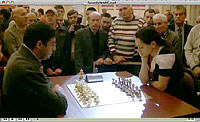
Grischuk-Carlsen in Round 11 of the 2013 London Candidates tournament, an event where time trouble thwarted the Russian's ambitions | photo: Anastasiya Karlovich
World Chess Champion Magnus Carlsen's secret is plain good ol' chess! Thus says Russian Grandmaster and World No. 3 Alexander Grischuk!
If you've been following the monthly chess ratings, you would recall that Grischuk gained a huge 15 rating points this past month to jump to World No. 3 behind Carlsen and Levon Aronian.
The comments about Carlsen were made in a detailed interview in Russian for the website R Sport. A very nice translation in English appears on Chess24.com. You will enjoy reading posts at both the links!
On Magnus Carlsen
What qualities have allowed Carlsen to dominate chess and become World Champion?
The guy simply plays chess well. It seems to me that in such cases people are inclined to look for some supernatural explanation, although the simplest explanation is also the most appropriate: the guy simply plays chess well.
How big is the group of players who are capable of competing with him in the coming years?
It’s hard to say because his results recently are undoubtedly impressive, but history shows that it’s very rare for any domination by one person to last for a very long period of time. The group of Magnus’ competitors isn’t so small – eight to ten guys.
From Alexandra Kosteniuk's
www.chessblog.com
Also see her personal chess blog
at www.chessqueen.com
Don't miss Chess Queen™
YouTube Channel

Also see her personal chess blog
at www.chessqueen.com
Don't miss Chess Queen™
YouTube Channel
Labels: alexander grischuk, chess ratings, Magnus Carlsen
posted by Chess Blog Admin @ 12:26 PM
0 Comments