USA's Top Daily Chess News Blog, Informative, Fun, and Positive
hosted by Chess Queen™ & 12th Women's World Chess Champion Alexandra Kosteniuk
Thursday, November 27, 2014
Chess and Art: Ryan Gander's Public Sculpture in Manchester Impresses
Hello chess blog friends, here's a chess and art motif again from Manchester - and a lovely one at that. We picked this up from the BBC News stream: A very interesting piece of art has been unveiled in Manchester!
The public sculpture in Beswick, by artist Ryan Gander, is made up of three giant stainless steel chess pieces with no indication of which side they're on.
The 9ft (3m) work, entitled Dad's Halo Effect, shows "it's not the winning that's important, but the taking part", Manchester City Council said.
The gallery's director Maria Balshaw said the Beswick work would "provide a source of inspiration for local residents of the area and visitors alike".
While the work represents chess pieces in a checkmate position, it is based on parts of the steering mechanism of a Bedford truck, which Gander was originally told about by his father who worked for General Motors. You can read the full report at the BBC site. From Alexandra Kosteniuk's www.chessblog.com Also
see her personal chess blog at www.chessqueen.com Don't miss Chess Queen™ YouTube
Channel
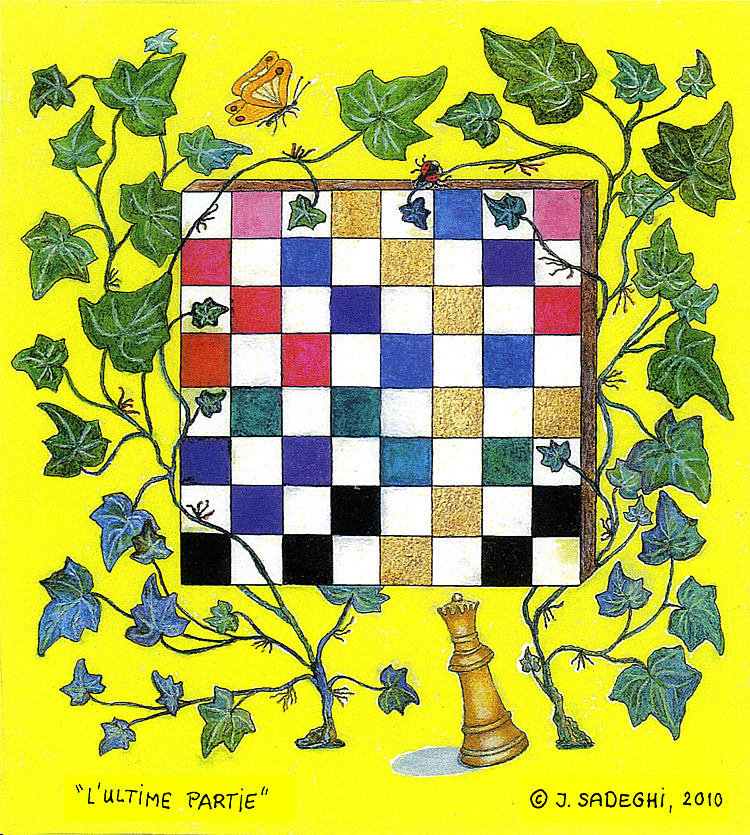
Beautiful Gold-Leaf Chess Painting by Swiss Artist Jacqueline Sadeghi-Baudet
Thanks to Jacqueline Sadeghi for sending us a copy of this beautiful chess painting!
Chess and its global (artistic) appeal
As the recent resolution by the European Parliament regarding teaching chess in schools has demonstrated, the noble game is of general interest and an integral part of modern culture. Through the centuries, this fact has been known, appreciated, and brilliantly used by countless artists in their literary, pictographic, musical, plastic, and cinematographic productions, adding to the logical beauty that artists of the chessboard have themselves unearthed.
To prove this point today, we are pleased to share an image of an inspiring recent ink, watercolor and gold-leaf picture/painting created by Swiss artist Jacqueline Sadeghi-Baudet, who has kindly given us the possibility to reproduce this piece which is in a private collection. For this painting, Mrs. Sadeghi-Baudet drew her inspiration from being the mother of a US chess master and having had to spend some time at the Valmont Rehabilitation Clinic, where she happened to be given the room once used by Vladimir Nabokov, known to chess players as the author of The Luzhin Defence (later brought to the screen by Marleen Gorris) and a distinguished lepidopterist. The French title to this picture is “L’ultime partie”, i.e. The Final Game.
World Chess Hall of Fame presents Anatomy is Destiny by Liliya Lifánova, with choreography by Davy Bisaro
Chess blog for latest chess news and chess trivia (c) Alexandra Kosteniuk, 2012
Hello everyone,
Liliya Lifánova’s Anatomy is Destiny was one of seven works featured in the exhibition OUT OF THE BOX: Artists Play Chess on display at the World Chess Hall of Fame from September 9, 2011 to February 12, 2012.
ST. LOUIS, MO.- The World Chess Hall of Fame presented Anatomy is Destiny by Liliya Lifánova, with choreography by Davy Bisaro and sound design by Sebastian Alvarez. The performance took place at the Contemporary Art Museum St. Louis on February 15, 2012 at 7:00 p.m. after a brief talk by Lifánova and OUT OF THE BOX: Artist Play Chess curator Bradley Bailey.
Liliya Lifánova’s Anatomy is Destiny was one of seven works featured in the exhibition OUT OF THE BOX: Artists Play Chess on display at the World Chess Hall of Fame from September 9, 2011 to February 12, 2012. Curated by Bradley Bailey, assistant professor of art history at Saint Louis University, OUT OF THE BOX: Artists Play Chess explored artworks that consider chess both at the formal level and at the level of actual play. Comprising a wide breadth of media, the selection of artworks by Tom Friedman, Barbara Kruger, Liliya Lifánova, Yoko Ono, Diana Thater, Gavin Turk, and Guido van der Werve demonstrate an integration of chess that goes beyond the visual, incorporating elements of play or strategy that invite the viewer to reflect on the game’s intricate operations.
Tribute to chess through paintings - Super video slide show
Chess blog for latest chess news and chess trivia (c) Alexandra Kosteniuk, 2012
Hi everyone,
Ready for some chess and art? Fetch your cup of coffee and switch off the cellphone for just about half and hour. Here is a beautiful slide-show video sent to us by Miroslav, chess lover and chess player from Paris. Enjoy. If you have a great chess video to share too, don't hesitate to email us.
Chess blog for latest chess news and chess trivia (c) Alexandra Kosteniuk, 2011
Hi everyone,
Here is something for those who love chess and history. There's going to be a super exhibition of a chess set, according to The New York Times. When the Metropolitan Museum of Art’s new galleries of Islamic art open on Nov. 1, among the treasures on display will be one of the oldest chess sets in the world. Sort of.The set has been dated to the 12th century, is made of stone paste and was found in Nishapur, a city in Northeastern Iran. It resembles today’s sets in most respects, but two of the pieces are different, so the set is actually a precursor of the modern version of the game, whose rules mostly arose in the late 15th century.
In the museum’s set, instead of queens, there are viziers, and instead of bishops, there are elephants, which were called fils, according to “Masterpieces From the Department of Islamic Art in the Metropolitan Museum of Art,” a book about the exhibition that is being published by the museum.
The viziers and the elephants moved differently, and were less powerful, than their modern counterparts, which probably made the game slower and less exciting. The viziers could only move or capture diagonally one square at a time; the modern queen is allowed unlimited movement in any direction. The elephants moved diagonally two squares at a time, while modern bishops can move any number of diagonal squares. The viziers could never attack each other.
Chess had started to spread to Europe a couple of centuries before the Metropolitan’s set was made and had already moved closer to the modern game there. The Lewis Chessmen, a trove of 93 pieces found in 1831 on the Isle of Lewis, in Scotland, which are believed to have been carved between 1150 and 1200 A.D., contain queens and bishops. (Thirty of the pieces will be on loan from the British Museum from Nov. 15 through April 22, 2012 at The Cloisters in Washington Heights.)
Don't be shy about contacting me
to share women's chess news
or to propose collaboration
Best chess wishes to you! Alexandra Kosteniuk
12th Women's World Chess Champion
Facebook, Twitter, Youtube