Great New Research: Move Chess Pieces Just by Thinking
Chess blog for latest chess news and chess trivia (c) Alexandra Kosteniuk, 2012
Hi everyone,
Here is an amazing article about a brain and chess study.
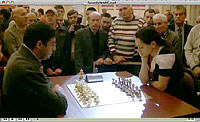
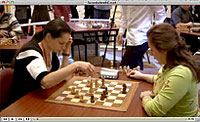
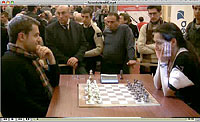
In Berlin they have a unique way of playing chess. The player sits motionless and, as if by magic, his pieces move around the board. His brainwaves are being harnessed so he can play just by thinking about the next move. The secret is in the headgear developed by researchers from Berlin’s Institute of Technology.

Researcher Michael Tangermann explained: “What we are seeing here is a brain-computer interface. It is a connection between the computer and the brain and it reads the intention of the player about the chess move he wants to make. It then converts it into a move. The player just needs to imagine which pawn he wants to move and where, then the computer recognises that and makes the move. So, the person can play without using his hands.”
Several electrodes measure brain activity in key areas and detect which piece the player intends to move. As soon as the player puts on the special cap, a system calibrates the software to recognise his or her specific traits - in this case it works on chess.
The brain-computer interface is not just for fun and games though. It could have serious medical applications, helping patients with severe motor neuron damage, for instance, to communicate with the outside world. Great that chess is a conduit to that!
From Alexandra Kosteniuk's
Also see her personal blog at
Labels: brain study, chess and brain
Your Brain is Wired Like a Chess Board, Says Study
Chess blog for latest chess news and chess trivia (c) Alexandra Kosteniuk, 2012Hi everyone,

We loved hearing this according to a new research - Our brain is wired like a chess board. How cool.
An article by Ted Thornhill in the MailOnline states that researchers always thought our brain was like a mass of tangled wires. However, that's changed as researchers have found the brain fibres to connect at right angles and crossing each other in directions of up, down, right and left making the whole brain system resemble the pattern of a chess board!
Van Wedeen, of Massachusetts General Hospital (MGH), who led the study, said: ‘Far from being just a tangle of wires, the brain's connections turn out to be more like ribbon cables - folding 2D sheets of parallel neuronal fibers that cross paths at right angles, like the warp and weft of a fabric.
What’s more, this grid structure has now been revealed in amazing detail as part of a brain imaging study by a new state-of-the-art magnetic resonance imaging (MRI) scanner. Read the full story here.
From Alexandra Kosteniuk's
www.chessblog.com
Also see her personal blog at
www.chessqueen.com
Labels: brain study, chess and brain, massachusetts general hospital, van wedeen
Interesting study on how Japanese chess Shogi players use brain more efficiently
Chess blog for latest chess news and chess trivia (c) Alexandra Kosteniuk, 2011
Hi everyone,
We enjoyed reading this study. It talks about how players of Japanese chess - shogi - use their brains more efficiently. We believe the same would apply to regular chess players as well. It talks of how experience and training can help master-level players shift some problem-solving stuff to their intuitive area and use their 'free cortext area' to focus on higher strategy and planning. Quite like linking up two hard discs to your laptop - we would say. Go on read the article.
Primates, particularly humans, are set apart from other vertebrates by more than a huge expansion of the cerebral cortex, the region of the brain used for thinking. The connection and coordination of the cerebral cortex with other, older parts of the brain also play a significant role, according to findings published recently in Science by a research team from the RIKEN Brain Science Institute (BSI) in Wako, Japan.
The researchers, led by Keiji Tanaka, found that professional players of the Japanese chess-like game of shogi can use part of brain associated with intuitive or habitual behaviors to establish a best next-move in a way that distinguishes them from amateurs. One result of experience and training seems to be the ability to shunt some immediate neural tasks from the cerebral cortex to the more intuitive basal ganglia, leaving the cortex free for planning higher-level strategy.
“Our findings may be regarded as showing that in amateur players problem-solving occurs mostly in the newly developed brain structure, but in professionals an important part of the process goes to the old brain structure,” Tanaka says. “This shift makes the process quick and unconscious.”
The work may have significant ramifications for training, particularly in understanding what constitutes an intuitive part of a job as opposed to the intellectual or educative part. It is also relevant to the development of computer expert systems. “The elucidation of such brain mechanisms may hint at a way to train engineers efficiently to become experts,” Tanaka explains. “Trouble shooting of computer networks, for instance, is dependent on intuitive insights of experienced engineers. They often focus on specific points of the network, but cannot explain why they do so.”
Using board games to understand the mind
Investigating mechanisms of higher brain functions of decision making has been one of the prime interests of Tanaka’s laboratory at BSI. An important question in this field, which has long been a subject of inquiry, is how experts differ from the rest of us.
Although psychologists have been studying the players of such games for more than a century, there has been almost no work on the underlying neural mechanisms. Consequently, differences in neural activity between the brains of amateur and expert players remain poorly understood. Tanaka and his team designed their study, in part, to provide much-needed data on brain function.
You can read further here.
From Alexandra Kosteniuk's Also see her personal blog at Labels: brain study, chess blog, shogi
Secret brain area study about chess players goes viral on the Internet
Chess blog for latest news and trivia (c) Alexandra Kosteniuk, 2011
Hi Everybody,
What's up with all these studies about how grandmasters use their brains? We're enjoying the research. Some days ago, remember reading our www.chessblog.com post titled 'Chess grandmasters do double the brain work'?An AFP story from Washington says, "Experts use different parts of their brains than amateurs, maximizing intuition, goal-seeking and pattern-recognition, says a new study that examined players of shogi, or Japanese chess." Researchers used magnetic resonance imaging (MRI) scans to compare the brain activity of amateurs and professionals who were presented with various shogi board patterns and were told to think of their next move.They found that certain regions of expert brains lit up, while the amateurs' did not, said the research led by Japan-based scientist Xiaohong Wan and published in the journal Science on Thursday. When they asked players to mull their next move, experts' brains showed more activity in the area associated with visualizing images and episodic memory, known as the precuneus area of the parietal lobe.When pressed to come up quickly with a move, activity surged in another region called the caudate nucleus, where goal-directed behavior is rooted."This activation did not occur in the amateurs or when either group took their time in planning their next move," said the study.Researchers believe that experts who train for years in shogi are actually perfecting a circuit between the two regions that helps them quickly recognize the state of the game and choose the next step.
"Being 'intuitive' indicates that the idea for a move is generated quickly and automatically without conscious search, and the process is mostly implicit," said the study. "This intuitive process occurs routinely in experts, and thus it is different from inspiration, which occurs less frequently and unpredictably."You can also read the Reuters report on the subject.From Alexandra Kosteniuk'swww.chessblog.comAlso see her personal blog atwww.chessqueen.com Labels: brain study, chess blog, chess research
|
|