The world's leading Women's Chess Blog, hosted by the Grandmaster
and Chess Queen™, Reigning 12th World Chess Champion, Alexandra Kosteniuk.
Friday, July 31, 2009
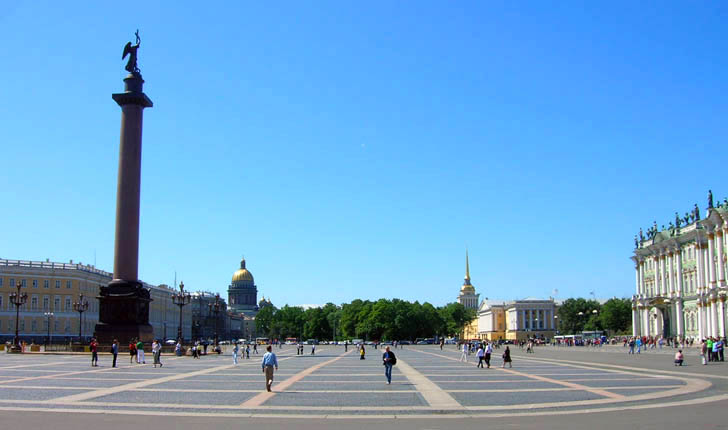
Baltic Queen Tournament in Saint-Petersburg, Russia
From August 10 till August 20, 2009 in Saint-Petersburg, Russia a very strong women closed chess tournament will take place.
The participants are: Pia Cramling (SWE, 2525), Ketevan Arakhamia-Grant (SCO, 2506), Elizabeth Paehtz (GER, 2474), Viktorija Cmilyte (LTU, 2470), Natalia Zhukova (UKR, 2465), Peng Zhaoqin (NED, 2418), Ekaterina Atalik (TUR, 2434), Anastasia Bodnaruk (RUS, 2388), Irina Turova (RUS, 2387) and Julia Demina (RUS, 2378). The tournament will be held by Saint-Petersburg Chess Federation, the main sponsor is OAO Gazprom. The schedule of the tournament can be found here.
I'm very glad to see that the Saint Petersburg Chess Federation is doing so many things for women's chess. This year European Women's Chess Championship was also held in Saint-Petersburg and now we will see another very strong chess women's tournament in this wonderful and beautiful city on the banks of the Neva river.
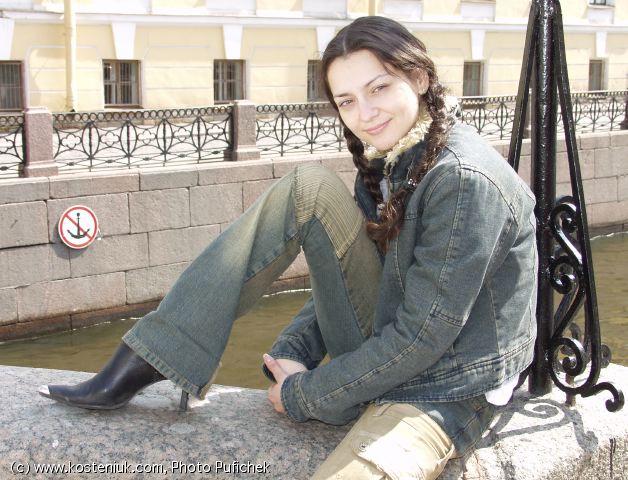
A small photo album of my visit to Saint-Petersburg in 2003 can be found here.
Posted by: Alexandra Kosteniuk Women's World Chess Champion www.chessblog.com
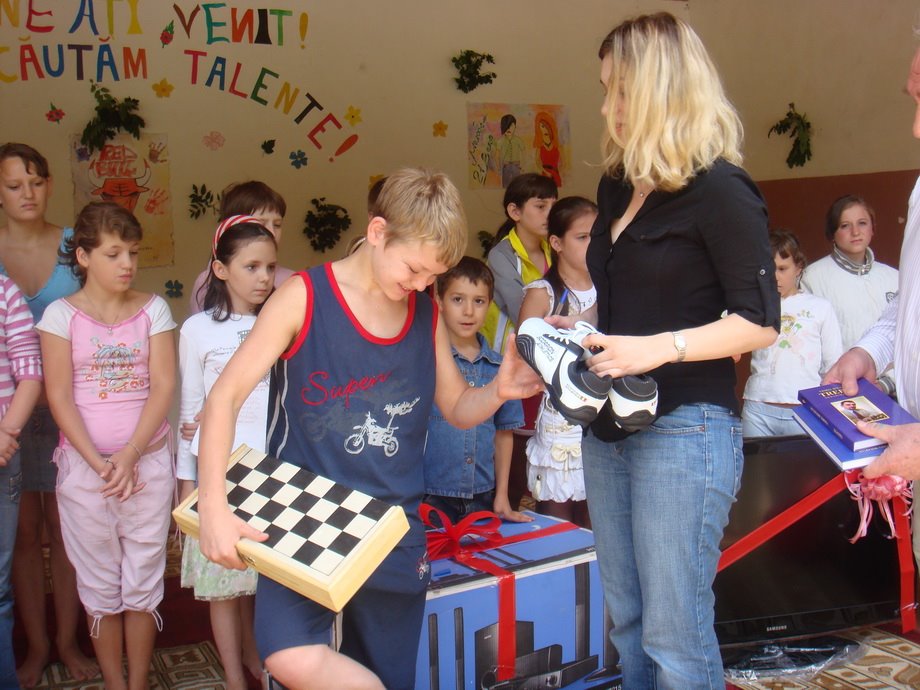
My best friend Almira Skripchenko sent me a few photos from her visit to an orphanage in Moldova.
Almira is originally from Moldova, but now lives in France. She was Women's European champion in 2001, three-times French champion, and represents France since 2002. Almira was rated as high as third woman in the world with a FIDE rating of 2498. She holds the titles of Woman Grand Master (WGM) and Men's International Master (IM).
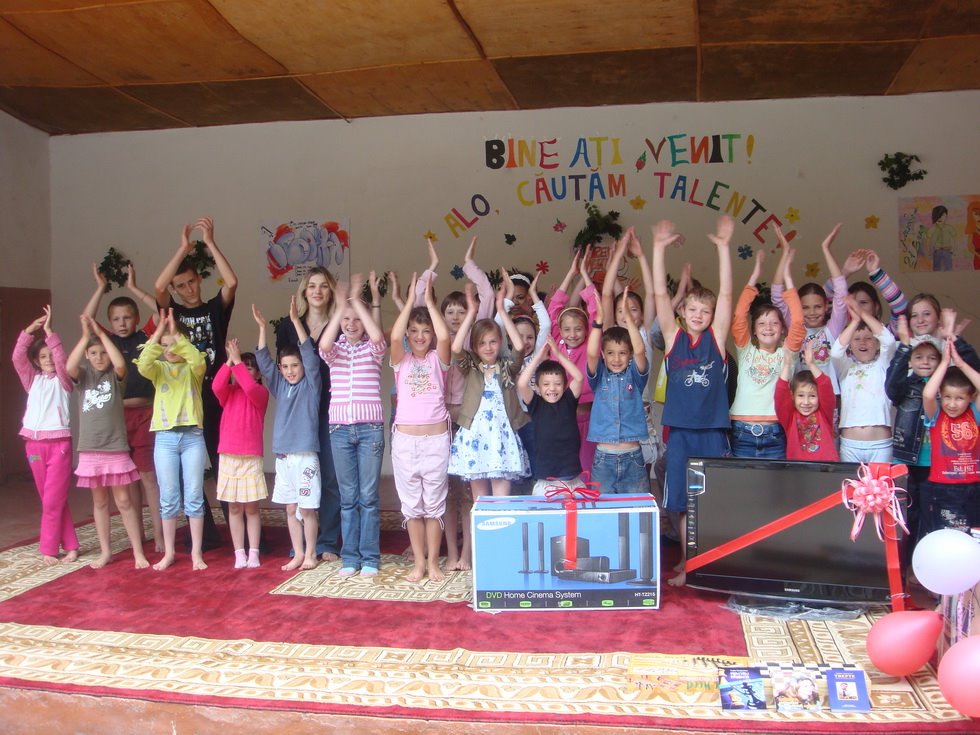
She visited the kids orphanage #3 of Kishinev and was greeted by the traditional bread and salt.
Almira brought many presents for each kid: chess sets, books, and sports shoes.
Almira also gave a big TV to the orphanage. Every kid was very happy and excited to see a famous chess player and promised to start playing chess as for the next time Almira comes be able to give her a hard time over the board.
The article in Russian about this goodwill visit can be read here.
It's great to read such great news. If every day one such event would take place somewhere in the world there would be many more happy kids in the world.
Posted by: Alexandra Kosteniuk Women's World Chess Champion www.chessblog.com
The treasurer of the Puerto Rico Chess Federation George Perez-Borrero let us know that:
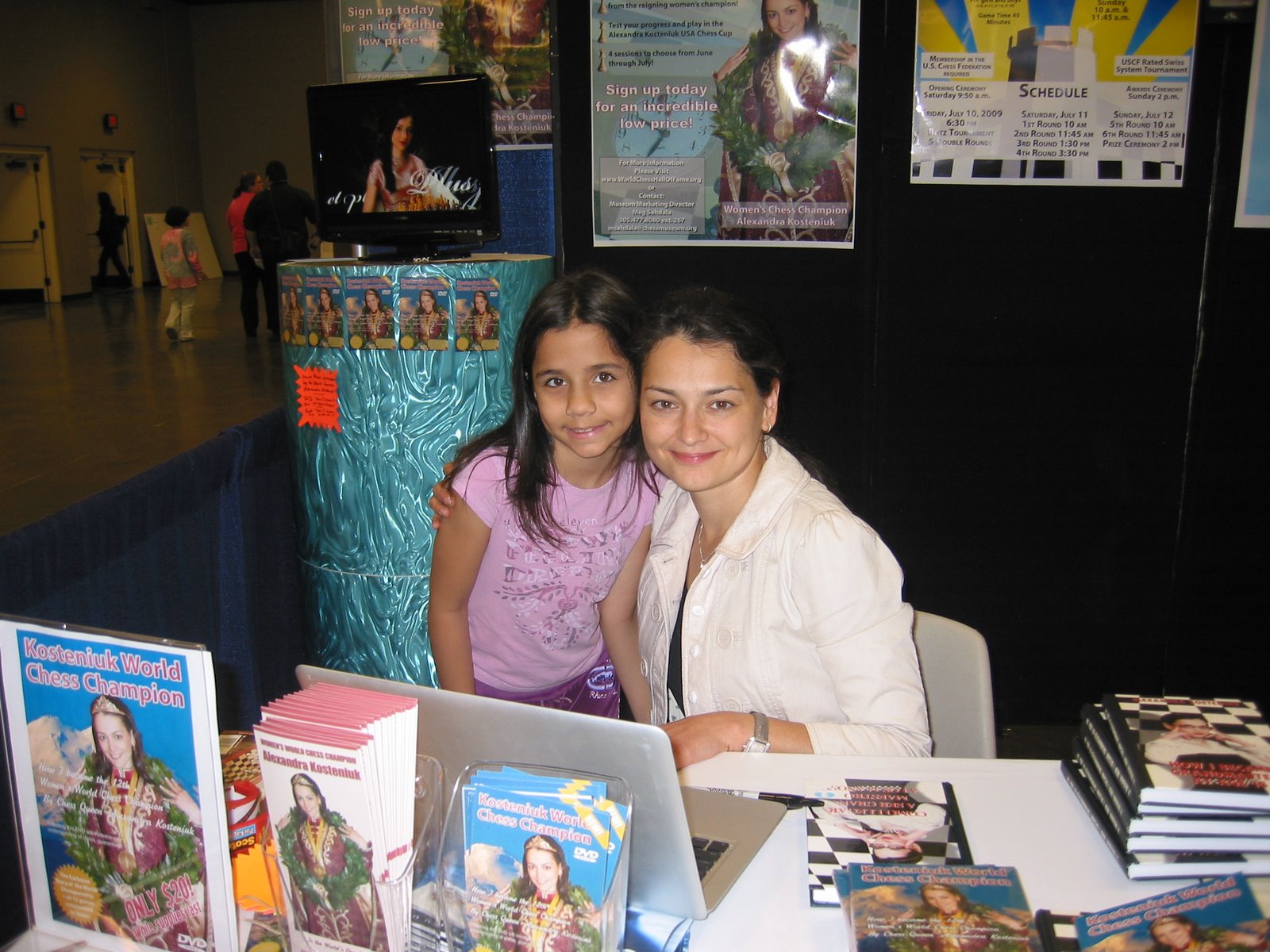
"The Puerto Rico Woman Chess Championship ended yesterday July 27, 2009 Tammy Segarra Choe revalidates as Puerto Rico Woman Chess Champion without losing a single game with 9 points out of 10. In second place and with only nine (9) years old Danitza Vazquez Maccarini (on the photo above with me in Nashville, april 2009) ended with 7 points after her victory in the last round over the WFM Jo Ann Alvarez Orta. Danitza ended with a rating performance of 1873."
Today I received an email from my friend IM Maxim Notkin from www.chesspro.ru who sent me the comments of GM Mikhail Golubev from www.chesstoday.net to the game between two Russian ladies Margarita Schepetkova and Svetlana Matveeva, it's a great game and I want to share it with you.
With their kind agreement I'm posting the commented game below.
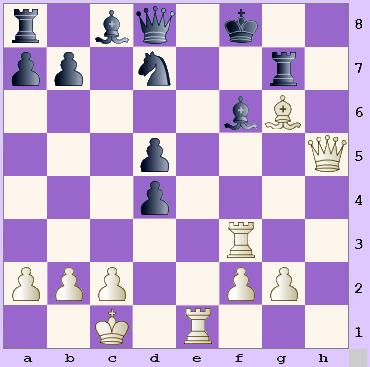
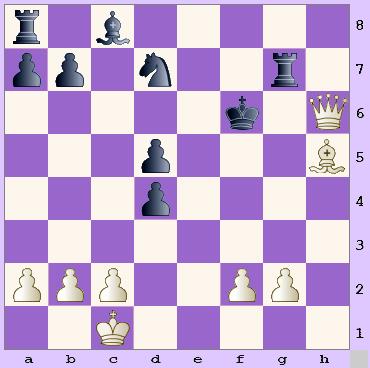
Schepetkova,Margarita (2207) - Matveeva,Svetlana (2410) [C14] 59th RUS-ch wom Higher League Voronezh RUS (2.11), 02.06.2009 [Mikhail Golubev (www.chesstoday.net)]
This game was played (in the spirit of old masters!) in the recently finished Russian Women's Higher League tournament (essentially: semifinal).
The sharp Alekhine-Chatard Attack is not very often seen in the modern tournaments.
6...f6 A known, but seldom played move.
7.exf6
[In the pre-computer era, famous was the game Panov-Yudovich, URS-Ch Tbilisi 1937: 7.Bd3 (White also can give a check from h5 first) 7...c5 8.Qh5+ Kf8 - it followed 9.Nxd5 fxg5 10.Rh3 g4 11.Nf4 Nxe5 12.dxe5 gxh3 13.Bxh7 Rxh7 14.Qxh7 h2!–+ and White's attack has failed completely. Indeed, the line is not forced, and the experts of this system could tell much more.] 7...Nxf6 8.Bd3 0–0 9.Nf3 c5 10.Bxf6
10...gxf6N
[White is attacking after 10...Bxf6 11.Bxh7+ Kxh7 12.Ng5+‚; So, 10...Rxf6 (transposing to a Maroczy-Billecard, Hastings 1895!) is almost surely safest.]
11.Ng5! 11...fxg5 [Black has to accept the sacrifice. Instead, clearly favouring White is 11...f5 12.Qh5 Bxg5 13.hxg5±]
12.hxg5 [White could have forced a draw by 12.Bxh7+ Kxh7 13.hxg5+ Kg7 14.Rh7+ Kxh7 15.Qh5+ Kg7 16.Qh6+ Kf7 17.Qh5+= . But she plays for a victory.]
12...Bxg5 [After 12...Rf7? White has 13.Bxh7+! Rxh7 14.Rxh7 Kxh7 15.Qh5+ Kg7 16.Qh6+ Kf7 17.Qh7+ (less clear is 17.g6+ Kf6 18.0–0–0 Nc6 19.Rd3 Nxd4 20.g7+ Kf7 21.Rg3 Bd7) 17...Ke8 18.g6 cxd4 19.Ne2± and the g6 pawn is unstoppable because after 19...Bf6?? (19...Bf8??) there is 20.Qf7# ]
13.Qh5 13...Rf7 14.Bxh7+ Kf8 15.Bg6! Rg7
[There was an alternative at this point. At least practically playable is 15...cxd4!? 16.Bxf7 dxc3 17.Qg6 Qf6 (another line is 17...Bd2+ 18.Ke2 Ke7 19.Rh7 Kd6 20.Qg3+) 18.Qg8+ Ke7 , etc.]
16.Rh3!
16...Nd7? [The line 16...cxd4?! 17.Qh8+ Rg8 18.Rf3+ Ke7 19.Rf7+ Kd6 20.Qxd4‚ looks frightening for Black to say the least; Most probably, critical was 16...Bf6! and, for example, 17.0–0–0!? cxd4 18.Nxd5 Qxd5 19.Qh8+ Ke7 20.Qe8+ Kd6 21.Qf8+ leads to the uncertain consequences, Black can play 21...Kc7 22.Qxf6 Rd7]
17.Rf3+ Bf6 18.0–0–0! cxd4 19.Nxd5! Nice, what to say.
19...exd5 20.Re1!±
20...Qe7?! [This loses by force. But after 20...a5!? (the best chance, preparing ...Ra6) the most direct 21.Qh8+ Rg8 22.Qh6+ Rg7 23.Re8+ Qxe8 24.Bxe8 Kxe8 25.Rxf6 Nxf6 26.Qxg7 Ra6 and here 27.f3! (preparing g4!) gives White a huge advantage.]
On July 27, 1904 a great Soviet chess player Lyudmila Rudenko was born.
The first women's world champion Vera Menchik died in 1944 during an air raid during the second world war. After the war in the winter of 1949–1950 the World Chess Federation (FIDE) held a tournament in Moscow to determine the new women's world champion. Sixteen women from twelve countries competed, with the four Soviet players taking the top four spots. Rudenko won, and held the Women's World Championship title until losing it to Elisabeth Bykova in 1953 in the next championship cycle. After the war, Rudenko's chess trainers were Alexander Tolush and Grigory Levenfish.
For those of you who know Russian, there is an interesting article about Lyudmila Rudenko here.
Every year in Saint Petesburg, the city where Rudenko lived for a long time, an annual women's tournament is taking place dedicated to the great chess champion. This year it will take place from August 25 till September 3, 2009. The information about the tournament can be found on the official site of the Saint-Petersburg chess federation, here.
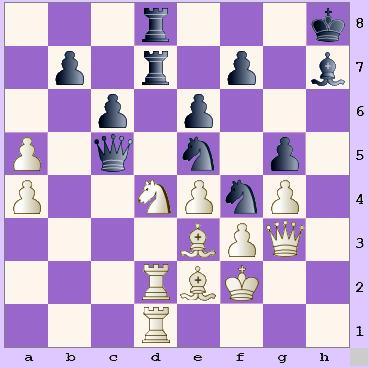
Here is a game between Lyudmila Rudenko and Clarice Benini from the women's world championship tournament of 1950.
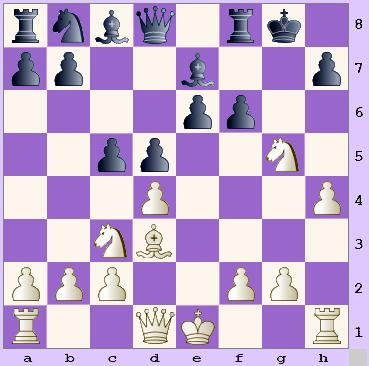
Black just played 37. ... Nf4. It's white to move. Try to find the continuation that Lyudmila Rudenko chose, later on you can have a look at the whole game, the pgn of which I'm adding below:
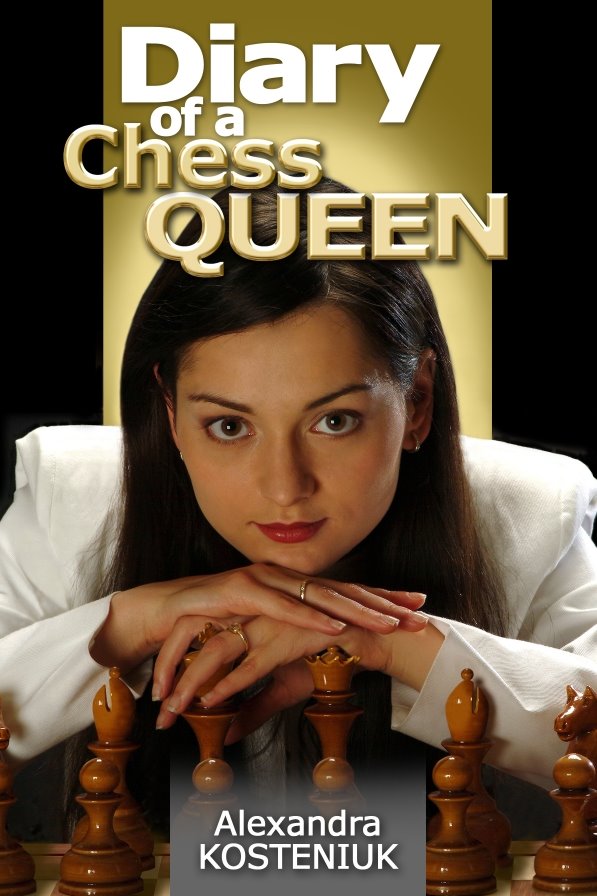
I'm very glad to announce that my new book "Diary of a Chess Queen" will soon be hitting the shelves.
The English version of the book will be published on December 1, 2009 and available to ship right after that.
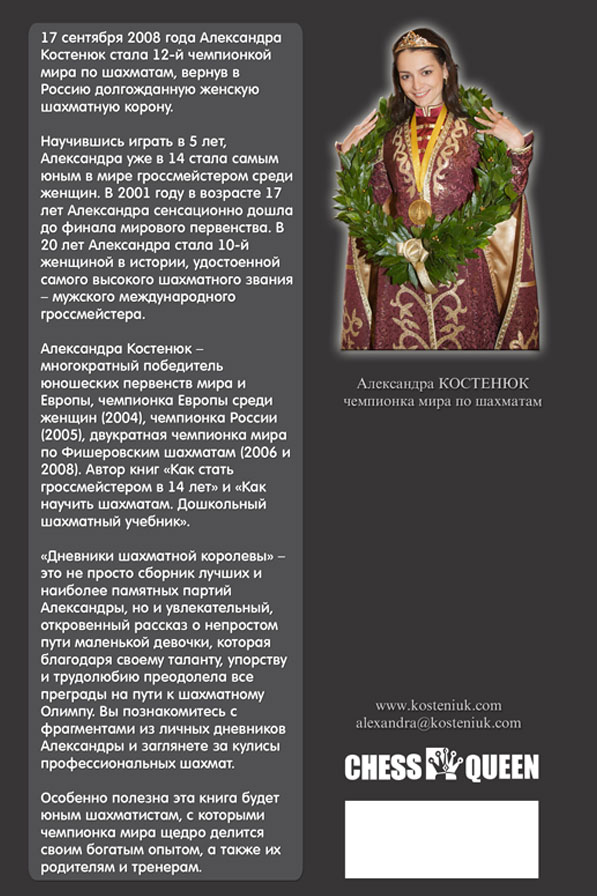
The Russian version "Дневники шахматной королевы" will be printed on August 18 and is available to ship in September.
Here is how the Russian version of the "Dairy of a Chess Queen" - will look:
I spent almost 6 months writing this book and hope that readers will like it, as I put all my heart and effort into it to make it my masterpiece with the best material I have ever created. There is much more text than usual, I would say over 1/3 is pure text and the rest are my best 64 chess games from my whole career, commented as best I could. Anatoly Karpov, the 12th world chess champion, wrote the introduction to my book.
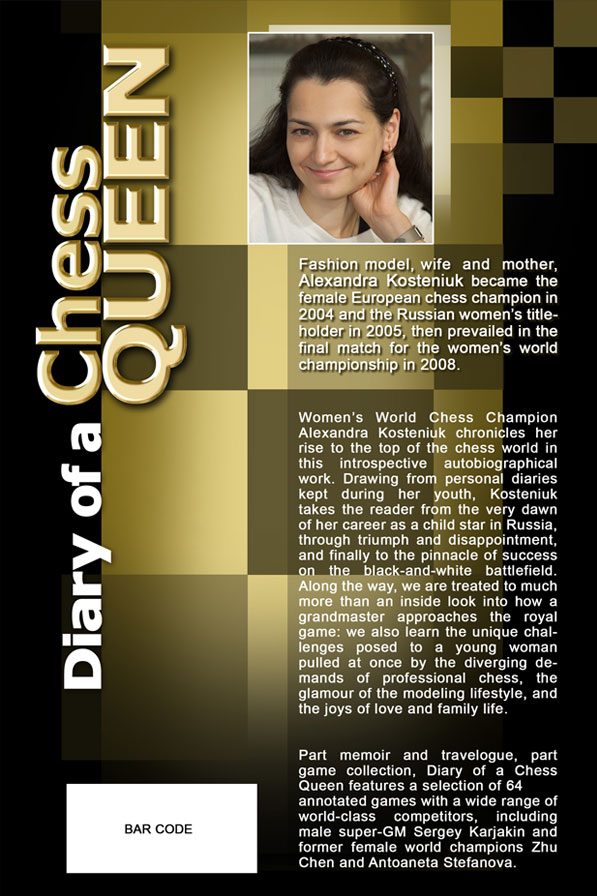
Here is a concise review of the book, by the publisher, Mongoose Press:
"Women’s World Chess Champion Alexandra Kosteniuk chronicles her rise to the top of the chess world in this introspective autobiographical work. Drawing from personal diaries kept during her youth, Kosteniuk takes the reader from the very dawn of her career as a child star in Russia, through triumph and disappointment, and finally to the pinnacle of success on the black-and-white battlefield. Along the way, we are treated to much more than an inside look into how a grandmaster approaches the royal game: we also learn the unique challenges posed to a young woman pulled at once by the diverging demands of professional chess, the glamour of the modeling lifestyle, and the joys of love and family life.
Part memoir and travelogue, part game collection, Diary of a Chess Queen features a selection of 64 annotated games with a wide range of world-class competitors, including super-GM Sergey Karjakin and former women’s world champions Zhu Chen and Antoaneta Stefanova. Fashion model, wife and mother, Alexandra Kosteniuk became the European Women’s Chess Champion in 2004 and the Russian Women’s Chess Champion in 2005, then prevailed in the final match for the Women’s World Championship in 2008."
From the first letter to the last word I wrote this book myself and I'm looking forward very much to having this book in my hands!
You can pre-order both the English and Russian versions NOW on www.chessqueen.com . Even with the autograph, we will be able to sell the book below retail price, $22.95 instead of $24.95.
By ordering your copy before it's printed, I will offer a free personal autograph to ev.eryone at no extra cost. Just email me the name of the person you want me to autograph it to and I will do so!
The direct link to buy the English version is here.
Posted by: Alexandra Kosteniuk Women's World Chess Champion www.chessblog.com
The treasurer of the Puerto Rico Chess Federation, George Perez-Borrero let me know today that: "The Final of the Puerto Rico Woman Championship, Puerto Rico National Women Championship -2009 is being held at the Casa de Ajedrez
in Caguas Puerto Rico from July 11, 2009 to July 27 2009. The institution of 9,753 square feet is the only installation dedicated exclusively to chess in Puerto Rico. The house was built at a cost of $1,6 million. Casa del Ajedrez "the House of Chess" opened its doors in October of 2006 under the direction of IA Rafael Ortiz Bonilla with the purpose of promoting the education and practice of the sport science."
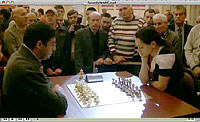
After eight rounds the Chess Champion of Puerto Rico en titre - Seqarra Choe Tammy is leading with 7.5 points, the 9 years old Danitza Vazquez is in second place with 5 points. On the photo below you can see the direct encounter between the leaders.The latest results can be seen here. For those of you who know Spanish, the official web-page of the Puerto Rico Chess Federation is here.
Posted by: Alexandra Kosteniuk Women's World Chess Champion www.chessblog.com
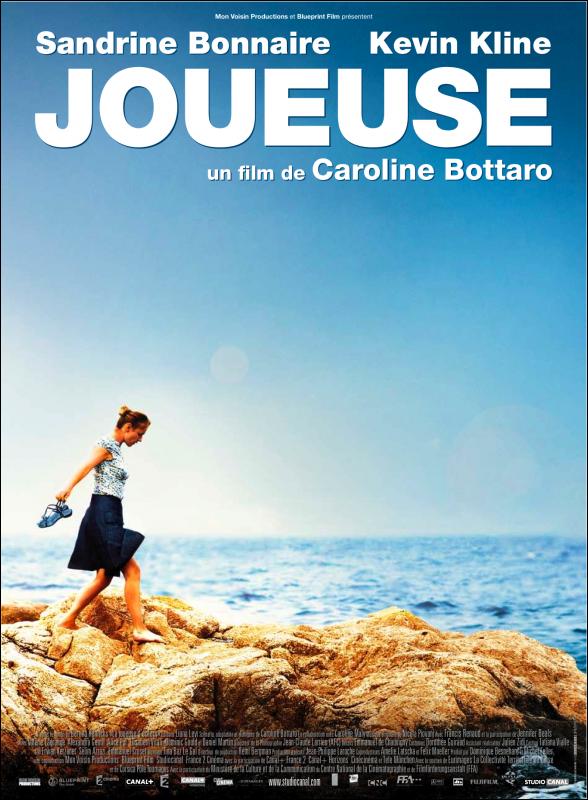
A new French movie "Joueuse" by Caroline Bottaro will come out on the screens of France on August 5, 2009.
Here is a preview of the movie:
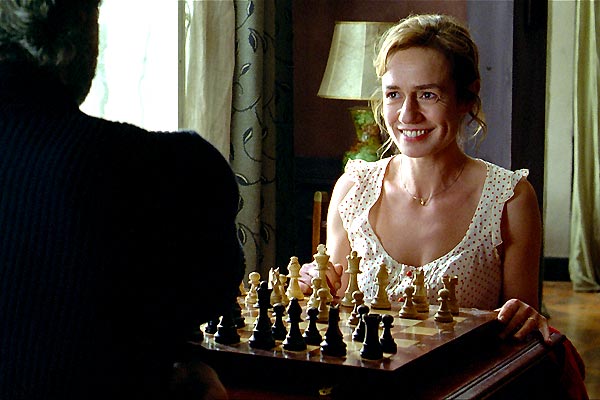
It's a movie about one woman, who is a housemaid. She lives an ordinary life, going from work to home and back. All of a sudden, one day, she sees a couple playing chess and falls in love (not surprisingly, uh?;)) with our game.
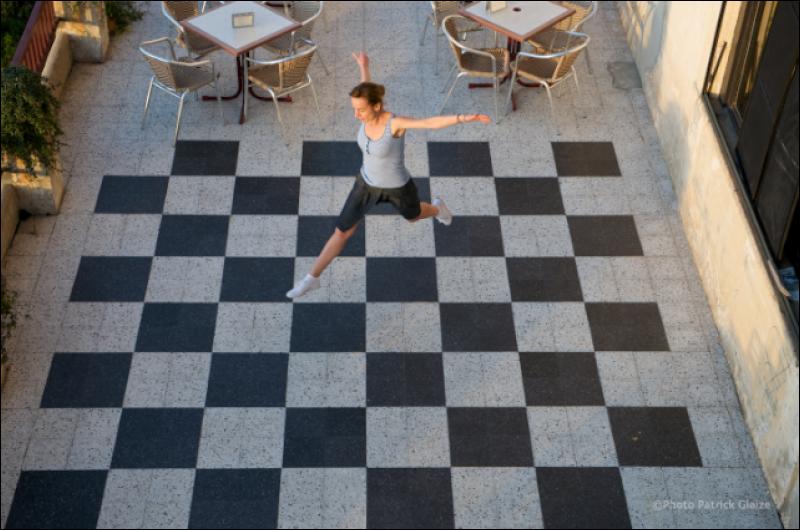
More photos from the scene and about the movie can be found here.
Kevin Kline and Sandrine Bonnaire are playing the main roles and I'm already looking very-very much forward to seeing this movie. I hope it will be shown not only in France but also worldwide. You can be sure I'd go to the cinema as soon as I can to watch this movie!
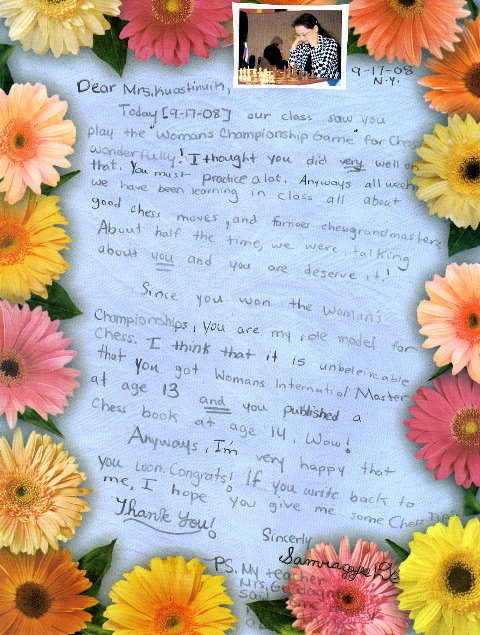
One thing that I like the most about being a role-model for boys and girls, something that makes my profession of chess-player and chess-educator so special, is the wonderful gifts, letters, emails and wishes, that young chess players sometimes send to me.
On the photo above, you can see a picture of me made by and sent to me by the young chess champion of Russia U-8 - Alexandra Obolentseva by the way she has her own web-site - http://www.sasha.su/
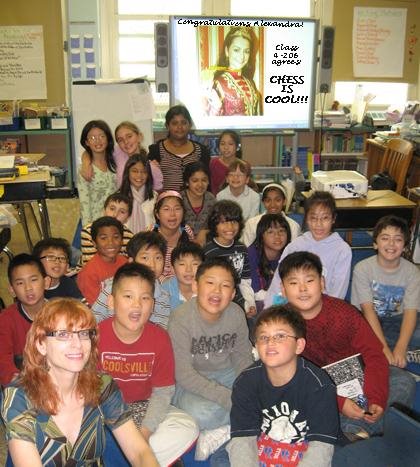
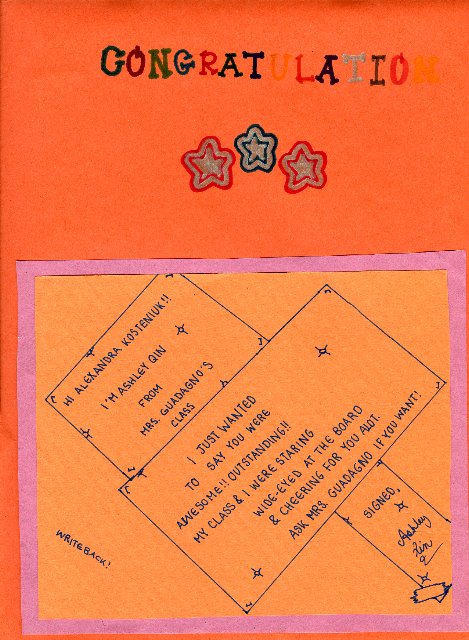
On the photos below you can see some letters that were sent by the Class 4-206 at P.S. 18, Queens, NY just after I won the world championship in Nalchik.
The most fascinating thing for me is to watch girls and boys playing chess. Despite being so young, they create, fight, they are trying to become better not only in chess but also in life. Chess often gives us the reason of living, it opens in front of us a wonderful world full of magic. We play, win or lose, we become a big part of this world. Fascinated by this ancient game, that came to us across the centuries. Thanks to all of you for these wonderful congratulations letters, special thanks to the teacher of this class Vicky Guadagno who inspires these young kids to study chess, and helps me in my goal to show the world that "Chess is Cool!
Posted by: Alexandra Kosteniuk Women's World Chess Champion www.chessblog.com
Today on my new Youtube channel - youtube.com/chesskillertips I published a podcast with the solution to the study of Troitzky that I posted a few days ago here.
Try to solve it on your own, then when you think you have the answer, you can check it right away by pressing play! The video is only 5 minutes and is very instructive.
Hint: If you know the famous chess study by Saavedra you will have an easier time. ;-)
You can also follow the official Twitter account @chesskillertips for updates on new episodes.
Posted by: Alexandra Kosteniuk Women's World Chess Champion www.chessblog.com Chess Queen's Women's Blog
Women's Chess Kaleidoscope: Spain, Greece, Canada and Poland
A little review of the recent chess results by the leading women chess players.
The tournament in San-Sebastian was won by Sophie Milliet (on the photo). She finished the tournament with 7 points out of 9, one point ahead of Yana Melnikova and Sadchev Tania who shared the second place.
Irina Krush shared the third place in a very strong Canadian Open. She took 7 points out of 9, drawing in the last round against Michael Adams.
Inspired by today's post about W. J. Baird I had a look one more time at my game against Maxime Vachier-Lagrave from the 2008 Paris Open.
During this game I created a very special idea but alas my opponent chose another continuation and at the end I lost that game. I realise now that simply adding a pair of pawns will be enough to make a real nice study out of this game.
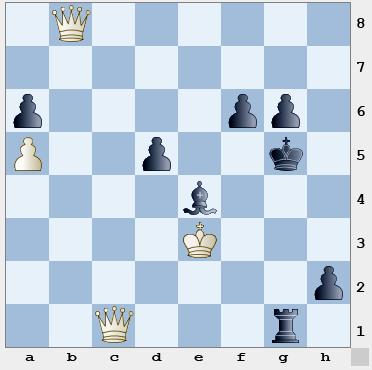
So here is the position of my study:
Kosteniuk, 2009 (inspired by the game Vachier-Lagrave, Maxime - Kosteniuk, Alexandra, Paris, 2008)
Black starts and White draws.
(in the original game against Maxime, there were no pawns on the a-file.)
Here is the solution to this study:
1...h1=Q!
The only move for Black here since after 1...Rxc1 2.Qf4+ Kh5 3.Qxh2+ Kg5 4.Qf4+ Kh5 5.Qxf6, White will be better since he will be able to win the pawn on a6 later on and create a very dangerous passed pawn
2.Kd4+! Rxc1
Black even loses after 2. ... Kh5?? since after 3. Qcf4! Rd1+ 4. Kc5 Rc8+ (or Qg1+) White king escapes to d6 5. Kd6 and Black has no defense from Qh8#
3.Qg3+! Kf5
After 3...Kh6 4.Qh3+! Kg7 ( 4...Qxh3 stalemate) 5.Qd7+ Kh6 6.Qh3+ It will be a draw by perpetual check or a stalemate
Thanks to my Google alerts I came across today's article by Lubomir Kavalek in the Washington Post.
Practically answering my question that I raised in a recent post about a female chess composer GM Kavalek at the beginning of the article writes:
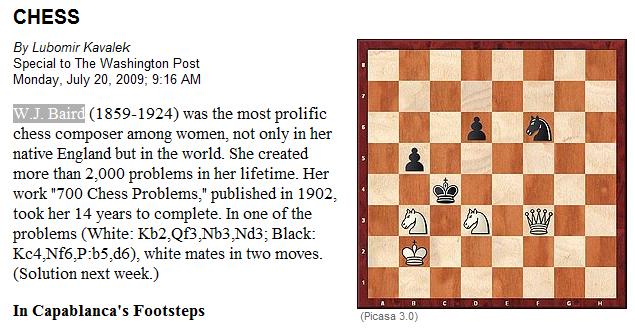
"W. J. Baird (1859 - 1924) was the most prolific chess composer among women, not only in her native England but in the world. She created more than 2,000 problems in her lifetime. Her work "700 Chess Problems," published in 1902, took her 14 years to complete. In one of the problems (on the diagram), white mates in two moves (Solution next week)."
The full article of Lubomir Kavalek in the Washington Post can be found here.
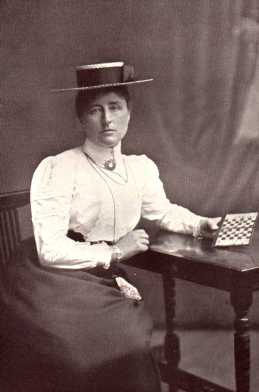
I made a little research on-line (you can find almost everything on the web these days) and found a few very interesting articles about Mrs. W. J. Baird.
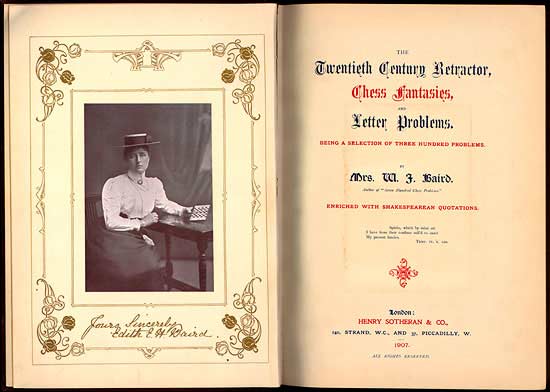
Edith Helen Baird (1859-1924), born Winter Wood, was the most famous female chess composer. She published her problems using the name "Mrs W. J. Baird." She composed over 2,000 problems.
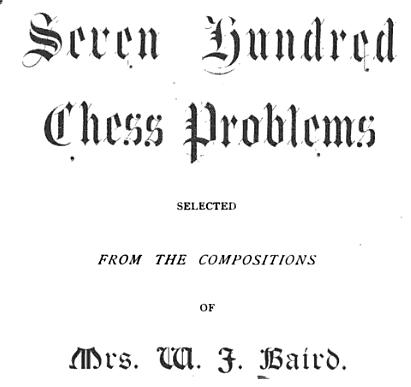
She published two notable books of her compositions - in 1902 the King's printer, Henry Sotheran, published her Seven Hundred Chess Problems, to be followed in 1907 by The Twentieth Century Retractor.
The first book can be found in the google books here.
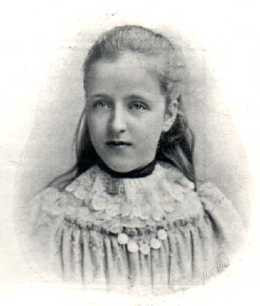
Edith had one child, Lilian, who, like all her Winter-Wood ancestors, seemed to imbibe chess with her mother's milk.
She was publishing problems before she was 10 years old. Frederick Gittins' description of her in his book The Chess Bouquet (1897) can hardly be bettered.
"Of Miss Lilian Baird we can only say that she is one of the marvels of the chess world. A child of thirteen, with long sunny golden hair falling back from a fine and lofty forehead, thoughtful eyes, and all the shy grace of childhood, she has already, in some mysterious intuitive way, learned the secret of problem-composing, and, absolutely unaided, has produced upwards of seventy compositions which have excited the admiration of the most critical judges. Some of the first composers of the day have dedicated problems to her honour, editors of chess columns are continually asking her to contribute, and people have asked her for her autograph - one of the surest evidences of fame. Like a wise mother, however, Mrs Baird seeks to keep her back rather than to press her forward, so she is now being kept mainly to her lessons and those natural pleasures of childhood to which even the most gifted boy or girl turns with joy. Like her mother, she writes verses quite charmingly and draws beautifully; but, with all her gifts, she remains a child and the happiest and mist industrious of schoolgirls. A childhood of such exceptional promise, and so wisely and affectionately guided and tended, can scarcely fail to lead up to a womanhood of rare fruition". The full article can be found here.
More about Edith E. Helen Winter-Wood Baird can be found here in English or here in German.
Posted by: Alexandra Kosteniuk Women's World Chess Champion www.chessblog.com
85 years ago FIDE (international chess federation) was created.
On July 20, 1924 in Paris representatives from fifteen countries signed the declaration to form FIDE. The original signatories were mainly European but today FIDE has 166 member federations in all Continents.
Starting from 1966 each year on July 20 FIDE celebrates the International Chess Day. Chess is a special game that unite people all over the world. More than 500 millions people play chess worldwide. Some very interesting chess photos can be found on the Visualrian web-site.
I want to congratulate all the chess players and people who love chess on this wonderful day! Let hope that one day battles and wars will take place only on chess boards.
One of the leading Russian chess web-sites www.chesspro.ru has a variety of very interesting chess articles, analysis and columns (it's in Russian but anybody should be able to follow the games quite easily). It also offers a live coverage of the most important chess events. Today I will let you know about the monthly voting for the best game of the month that is run by Maxim Notkin.
Once a month Maxim chooses the most interesting 12-20 games and sends them to GM's with the request to choose their top 10. The game with the top number of GM votes is considered to be the best game of the month. At the end of the year GM's look at the 12 best games of the year and choose the best game of the year. For example here you can find the best games of the year 2008. The top voted game of the year 2008 was a win of Veselin Topalov over Vladimir Kramnik in Wijk-aan-Zee 2008.
You can watch here Maxim's suggestion of 19 best games of June 2009.
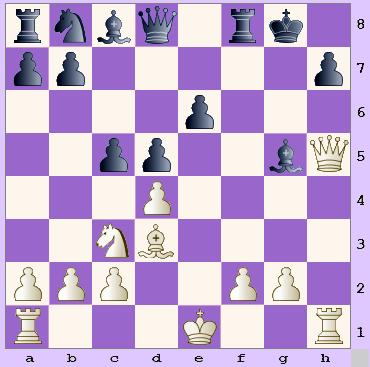
Among these 19 games, one is from the higher league of the Russian Women's Championship between Margarita Schepetkova and Svetlana Matveeva. It's very nice, have a look:
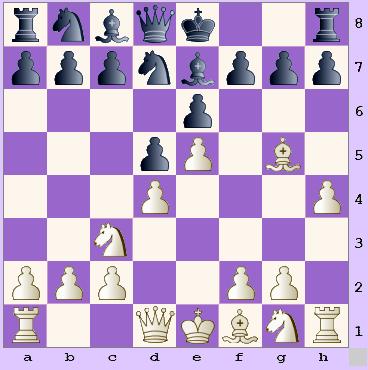
You can see the position after the 10th move of Black. It's White to move.
Margarita found a very nice way to continue the game and won in a very convincing style.
The first place with 1730 ACP points out of 6 events went to Tatiana Kosintseva (on the photo).
The second with 976 points out of 4 events was myself - Alexandra Kosteniuk and the third place went to Natalya Pogonina with 883 points out of 4 events.
The rules of the ACP women' series tour can be found here. The full standing with all the winners of 2008-2009 can be found here.
Posted by: Alexandra Kosteniuk Women's World Chess Champion Chess Blog for Women www.chessblog.com
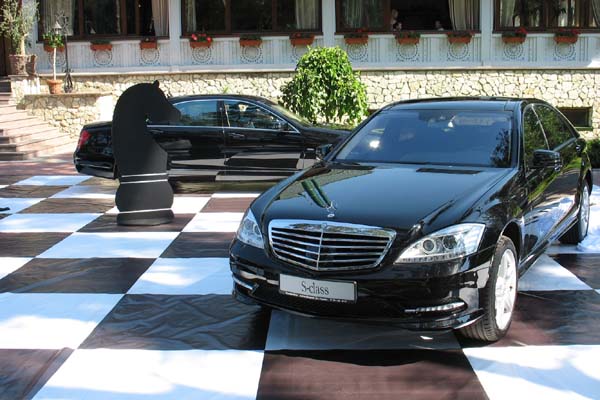
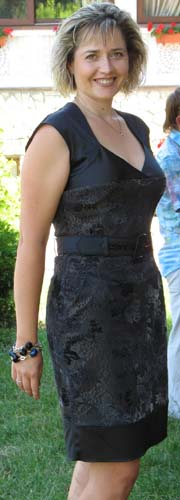
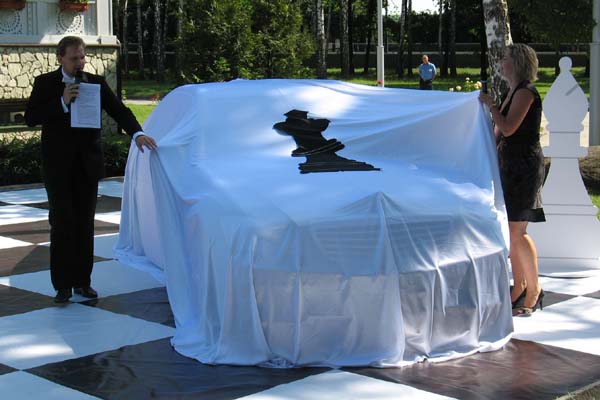
Today I received an email from my friend Chess Grandmaster Natalia Zhukova. She wrote to me about a very special presentation by the automobile company Mercedez-Benz that took place in Kiev, Ukraine.
Natalia was invited to the special presentation of 3 newest Mercedes-benz car models, very modern and very technologically "intelligent". If we look at the main colors of this series, which are Black and White, analogies to chess become almost inevitable.
Natalia Zhukova hosted the Chess Show and gave a chess simul.
More photos and the full article in Russian can be found here.
Posted by: Alexandra Kosteniuk Women's World Chess Champion www.chessblog.com
Today I got this message from Bernard Ouimet of the Championnat de Montreal, which will take place on the 11-12-13 September:
"You know a Female Grand Master at Chess (WGM)? Tell her we have a plane ticket and free lodging for her. We need the participation of a female Grand-Master to promote chess for Canadians, Quebec and Montreal women. We also have a free visit to the Zoo and to the biggest amusement park in Canada. We have about 350$US for her small expenses also"
There are also three women prizes in the lower sections of play. These prizes are over and above the total guaranteed prize fund of 5 000 $. Those extra prizes are offers by Goddesschess.
I congratulate both the Championnat de Montreal and Goddesschess for this excellent initiative!
Women's Chess Kaleidoscope: Sweden, Germany, Spain, Canada, Scotland and many more.
Summer is usually hot not only in terms of the weather conditions but also in terms of number of very interesting tournaments. Women achieved a few noticeable results playing in men's competitions this week.
Pia Cramling (on the photo below) became the runner-up of the Swedish Championship. She finished second with 8,5 points out of 13.
Elizabeth Paehtz with whom I met for the first time over the board in 1994 finished third with 6 points out of 11 in a strong closed tournament in Berlin.
A few interesting tournaments are going on right now. Diputación Foral de Gipuzkoa Tournament in San-Sebastian is still under way. After 6th rounds Sophie Milliet and Jana Melnikova are sharing first place with 5 points. They are followed by Sachdev Tania and Regina Pokorna with 3.5 points.
Scottish Chess Championship is taking place from July 11 till July 19 in Edinburgh. After 3 rounds GM Ketevan Arakhamia-Grant is sharing the third place with 2.5 points.
The Canadian Open Chess Championship started a few days ago, many strong GM's are taking part in this open, including Alexei Shirov and Michael Adams. A few very strong women chess-players are also playing in this competition such as Zhao Xue (2544) and Irina Krush (2481). At the end of this post enjoy this nice ending combination from the 12th round of the Swedish Championship between Pia Cramling (white) and Blomqvist (black).
It's White to move and it seems that even though the Black's position is passive but at least it's quite solid. In fact, Pia will need only 5 more moves to finish the game.
29. Nc5! a fork! Using the fact that after taking on c5, the d-file becomes an open-file and the rook on d1 will be at the right time in the right place. 29. ... Bxc5 30. dxc5 Ke7 (the pawn on c5 is untouchable since after 30. ... Nxc5 White will win the knight by playing 31. Nd6+) 31.Rcd2! (doubling rooks on the open-file) Nf8 32.Nb6 Re8 33.Rd7+! delivering the final blow. Black resigned. 1-0
Here is the pgn of the whole game. You can review it by simply copying and pasting into pgnplayer.com [Event "ch-SWE"] [Site "Kungsor SWE"] [Date "2009.7.10"] [Round "12"] [White "Cramling,P"] [Black "Blomqvist,E"] [Result "1-0"] [Eco "D17"] 1.d4 d5 2.c4 c6 3.Nf3 Nf6 4.Nc3 dxc4 5.a4 Bf5 6.Ne5 Nbd7 7.Nxc4 Nb6 8.Ne5 a5 9.e3 g6 10.Bd3 Bxd3 11.Nxd3 Nbd5 12.Qb3 Qb6 13.Qxb6 Nxb6 14.Ke2 Bg7 15.b3 O-O 16.Bd2 Nfd7 17.Rac1 e6 18.Ne4 Ra7 19.Rhd1 Rd8 20.Be1 Nd5 21.Nd6 Bf8 22.Nc4 Rda8 23.e4 Nc7 24.f3 f6 25.Rc2 Ra6 26.Bf2 Rd8 27.g4 Kf7 28.Be1 Rda8 29.Nc5 Bxc5 30.dxc5 Ke7 31.Rcd2 Nf8 32.Nb6 Re8 33.Rd7+ 1-0
Posted by: Alexandra Kosteniuk Women's World Chess Champion Women's blog www.chessblog.com
I'm glad to announce that the 1st Alexandra Kosteniuk's USA Chess Cup for kids that was held on July 11, 2009 at the Miami Chess Academy was a big success!
33 young players took part in this event. I thank all the participants and the owner of the Miami Chess Academy Blas Lugo for helping to create this special event. I hope to organize Alexandra Kosteniuk's USA Chess Cup for kids every year so many more kids can participate. All the participants of the Alexandra Kosteniuk's USA Chess Cup got prizes and medals. More than 1,000$ in prizes was awarded and no kid left without a medal and a prize.
Below is the list of the winners. It was a mixed tournament, that means that everybody played in one group and all the participants had a chance to win the Grand Prize.
The 1st Grand Prize was awarded to Robert Perez (USCF rating - 2124) who got 7 out of 7! The second Grand Prize was awarded to Jose Dias who took 5.5 points out of 7. The third Grand Prize with 5.0 points out of 7 was awarded to Jonathan Lau who is only 9 years old! The top girl of the tournament was Annaby Pozo with 5.0 out of 7, congratulations!
The 1st prize in the category U-14 was awarded to a 8-year old Henry Qi with 5.0 points out of 7. 2nd prize went to Lance Shkolnik with 5.0 points out of 7 and on the 3rd place in this category was Terry Song with 4 points. The top girl in this category was Juliana Piloto with 4 points out of 7.
The 1st prize in the category U-11 went to Sebastian Sosadiaz (4.5 points out of 7). Second prize was awarded to Matthew Solis with 4.5 points out of 7. And the third place in this category went to William Yang with 4.0 points out of 7. The top girl prize in this category was awarded to Erika Medina.
The 1st prize in the category U-8 was awarded to Juliana Piloto. 2nd prize was awarded to Dima Tertychnyi with 4.0 points. The 3rd prize went to Justin Landrove (4.0 points). The top girl in this category was Arisha Shtypel.
Congratulations to the winners and hope to see you next year!
Posted by: Alexandra Kosteniuk Women's World Chess Champion www.chessblog.com
The 3rd session of my chess camp is over, tomorrow the 1st Alexandra Kosteniuk's USA CHESS CUP for KIDS will take place. Here is some info about the tournament:
11 July 1st Alexandra Kosteniuk USA KIDS Chess cup tournament
5880 SW 8th St, West Miami, FL, 33144-5036 (305) 262-2700
5 Rounds Time Control: Game/25 minutes
Trophies: Top 3 individuals in each age group + 1 top girl in every age group.
4 age groups Girls and Boys Under 18 – Born after July 11th, 1991 Girls and Boys Under 14 – Born after July 11th, 1995 Girls and Boys Under 11 – Born after July 11th 1998 Girls and Boys Under 8 – Born after July 11th 2001
Prizes: 1st - $200 in chess prizes + 1 private lesson with Alexandra, 2nd - $100; 3rd - $50 in chess prizes
Registration Saturday 11-11:50am. First round starts at 12pm.
After this tournament I will go for a deserved vacation to Disney World and then will start preparing for the US-open that will take place from August 1 till August 9, 2009 in Indianapolis, IN.
Posted by: Alexandra Kosteniuk Women's World Chess Champion www.chessblog.com
Here is a nice tactical example from the game of the first women's world chess champion Vera Menchik and George Thomas of 1932. The game started with the King's Indian Defence and we can see that White is attacking on the king side and Black is attacking on the queen side.But some of the White pieces (like the knight on c3) are there to protect White's king, while Black left the Black monarch alone and Menchik uses this factor, finishing the game in a nice precise way. Black just played 19. ... a3 and it's white to move. . Menchik played 20. f6+! Black can not take now on f6 since after 20 ... Kxf6 21. Qg5+ Kg7 22. h6+ Kg8 23. Qf6 threatening to play Qg7# Black will not have any defence from the checkmate. So in the game Black played 20. ... Kh8 21. Qh6 axb2+ 22. Kb1 Rg8 23. hxg6 fxg6 and here it's White to move again and Menchik finished the game with a very beautiful tactical blow.
Vera Menchik played 24. Qxh7+! and Black resigned since after 24. ... Kxh7 he will be checkmated after 25. Rh1# Here is a pgn of the game. That you can copy and paste into the pgnplayer.com and then replay the whole game.
Together with a super GM's men tournament with an average rating of 2682, a very strong women's closed tournament will start tomorrow, July 7, in the spanish city of San Sebastian. Gipuzkoa Regional Government or “Diputacion” sponsors this women event. The tournament has a 2318 average in a women category 11 and category 3 tournament.
The players of the Diputación Foral de Gipuzkoa Tournament are: Tania Sachdev (2410), Milliet Sophie (2388), Pokorna Regina (2381) (on the photo below), Michna Marta (2379), Hamdouchi Adina-Maria (2324), Zakurdjaeva Irina (2305), Melnikova Yana (2285), Ionica Iulia-Ionela (2263), Rozic Vesna (2239) and Karlovich Anastazia (2211).
The pairing of the first round:
1 WGM Hamdouchi Adina-Maria 2324 - WGM Pokorna Regina 2381 2 IM Milliet Sophie 2388 - WGM Karlovich Anastazia 2211 3 WGM Zakurdjaeva Irina 2305 - WGM Michna Marta 2379 4 IM Tania Sachdev 2410 - WGM Melnikova Yana 2285 5 WGM Ionica Iulia-Ionela 2263 - WIM Rozic Vesna 2239
Here is a very nice study by Alexey Troitzky of 1924 that I really enjoyed. It's White to move. It's quite difficult so don't lose heart if you can not solve it. In one week I will make a new episode of chesskillertips with the answer to this study.
By the way, I have never heard about a female chess composer. If you know any, please let me know.
Posted by: Alexandra Kosteniuk Women's World Chess Champion www.chessblog.com
I'm glad to introduce today a very strong chess player and a very gifted young lady: Yelena Dembo. Yelena has a very interesting story, she was born in Russia, later on moved to Israel, then lived in Hungary and eventually moved to Greece where she lives today. Yelena started to play chess as early as the age of 3 and competed in her first tournament when she was only 3 year and 9 months. When one say that there is not enough time in life for many things Yelena is proving otherwise. She's not only playing chess but also writing successful chess books. She has her own web-site - www.yelenadembo.com and she wrote and published several chess books.
What is your place and date of birth?
I was born in Penza (USSR) on the 8th of December 1983.
How did you start playing chess?
I started playing at the age of 3 years and 3 months. I played in my first tournament among boys aged 8-12 when I was 3 years and 9 months old.
What are your main achievements in chess?
I have 8 medals from the World and European championships, including the gold medal in the 2002 European Rapid Championship for girls under 20 in Novi Sad, Yugoslavia and, most significantly, the bronze medal in the European Women’s Championship 2005!
1st place in Hungarian women’s championship 2003 with 7,5 points out of 9 games.
I shared 1st place in the 2003 Acropolis WGM Tournament in Athens, Greece with a result of 6,5 out of 9!
My team won the silver medal in the 2003 European Women’s Team Championship in Plovdiv, Bulgaria where I played on the first board. My result was 6 out of 9!
I won the Bykova Memorial Tournament in Vladimir, Russia, in December 2004!
I won the bronze medal in the 2005 European Women’s Championship in Moldova!
I finished tied for 6th place in the very strong Hamburger Schachfestival, making a GM norm in the process with a performance of over 2600!
I tied for 3rd place in the 2006 European Women’s Championship in Turkey!
I tied for 3rd place in the 2007 Mediterranean Championships and won the Women’s title!
I tied for 2nd place in the 2008 European women’s Championship in Bulgaria.
I have more than 140 games published in the famous Yugoslav publication “Chess Informant” with my analysis and novelties. One can also find several of my games in the Encyclopaedia of Chess Openings.
What is your peak rating?
2470 in 2007 (now it's 2469 :-) ).
How did you start writing chess books?
It all started in 1992 when my parents who had their private chess & music academy in Tel-Aviv, Israel, started gathering middlegame examples for their collection :-) Around this time they also thought of the special “Dembo rules” which would help me and their students to develop better general chess understanding. Thanks to these rules and methods their students have won 30 gold medals in Israeli youth championships during eight years only! The level of juniors has risen incredibly quickly (so quickly that one of the students won the gold medal in the rapid world championship under 14). During a short time the children became more clever and more gifted. So, since I started teaching officially at the age of 13, this system was naturally very interesting for me. And already when I was 17 I had the idea to write a serious book about it. Therefore, when I became men’s IM (an objectively strong player) I started writing this book. The book was published in 2005. Then, so many people bought the book (including very strong GMs) that I started thinking about a new book! :-)
How many books have you already written?
Five books have already been published and now I am finishing working on the sixth.
How long does it take to write a chess book for you?
It depends on the subject of the book, on if I need to gather material, select it, analyse it. Usually it takes from 6 months to a year.
Why do you think there are not so many women who are writing chess books?
I think it is more correct to say that there are only few women who write books :-) The reason is very simple – it is very difficult to write. It is necessary to understand the material very well, not to be afraid to let the world know about your opinion, to be able to prove this opinion, it is necessary to be a good writer, to explain the material very well, to know the language well, it is necessary to also be a quite high level player, etc.
Can you tell us more about your books?
My first chess book, “The Very Unusual Book About Chess”, is about the middlegame and contains several interesting methods of playing this part of the game, complemented by many instructive examples by the world’s leading players (Kasparov, Anand, Kramnik, Shirov, Sutovsky etc.) on each method. The book is available in English and Russian. It is 136 pages long and includes detailed verbal comments, special “Dembo-rules” and a very interesting and useful large chapter on gifted moves! I am sure that someone who studied this material will be able to find these gifted moves in his games as well!
About The Author 5 Symbols & Abbreviations 6 The Purpose of this Book 7 Preface 8 Chapter One - Opening Problems 9 Chapter Two - How to Improve Part One 13 Chapter Three - How to Improve Part Two: Evaluation 25 Chapter Four - How to Improve Part Three: Choosing a Plan 82 Chapter Five - How to Improve Part Four: Recommendations - 104 Chapter Six - How to Improve Part Five 124 Index of Players 133
In late 2006 I have received an e-mail from Everyman Chess, the most significant chess publishing house of our times with compliments about my first two books and an offer to write for them. I gladly accepted!
The products of our cooperation so far: Play The Gruenfeldwas my first opening book, released in mid-2007! It provides a complete repertoire in the Gruenfeld Defence for the player with Black. Next came Fighting the Anti-King’s Indians: How to Handle White’s tricky ways of avoiding the main lines , which covers all of White’s possibilities after 1 d4 Nf6, with the exception of 2 c4, as well as advice and King’s Indian solutions to 1 Nf3 and 1 c4. The book was published in the second half of 2008.
My latest effort is a contribution of a few chapters in Dangerous Weapons: The King’s Indian. Other contributing authors are GM Glenn Flear and IM Richard Palliser. This book was published in early 2009.
Now I am finishing to write a guide book on the Scotch Game.
Do you consider yourself a professional chess player, chess trainer or chess journalist?
I consider myself a professional chess-player, professional trainer, professional writer and professional chess-journalist!
How often do you study chess? How many hours a day?
I try to study 4-6 hours every day but it depends on many things such as my tournaments, students, books, family.
Do you have a chess trainer or you study chess by yourself?
My dad works with me since I was little. Many years ago he taught me and now I only use his advices. During some periods in my life I took lessons from others trainers but it didn’t influence me much.
What do you study most: openings, middle game or endgames?
Naturally I try to divide my time in such proportions that I would study all chess :-) Especially, to study what I think I need at this time.
Do you prefer to play chess with men or with women?
There are so few strong women’s events where I can play that I have no choice but to play in men’s events, especially since I want to fulfil the men’s GM title (I already have one norm).
Why do you think men are stronger than women in chess?
You know, this question always surprises me, although I hear it all my life. It is possible to look at it from two sides. First, in one reality most men (including chess-players) live for their careers. They usually deal only with their job. They do it for years, many hours each day and usually they don’t have any more problems :-) So how is it possible not to be a good specialist after such work :-)? They work all their life to have best results. Women have a totally different situation – they have to take care of the family, of the kids, food, laundry, ironing, cleaning of their apartment or a house (usually the wife does all the work in the house) and to be a professional player. So how can she have the same result as the man?
Secondly, I think that nature generally gifted men with more possibilities and I don’t see anything unusual or bad in it for women. Of course, there are many very good women violinists, pianists, etc. But generally it is not serious to compare men and women. It is better not to fight with nature! :-) And in chess it’s the same: you, me and many other players have many wins over GMs (and very strong GMs!) but I don’t think that women will be able to play like Kasparov, Fischer, Tal, etc.
When did you feel happiest about being a chess player? Why?
It’s difficult to name just one. I can be very happy when I manage to play a very interesting game, win against a strong player, win a strong tournament, when people tell me that after reading my books they like chess much more. But maybe my happiest moment was 6 years ago when Sotiris Logothetis as an organizer invited me to play in the Acropolis tournament and in 6 months we got married :-).
If you had not become a chess player what career would you have chosen?
I have never imagined anything else :-).
You were born in Russia, then moved to Israel, then played for Hungary and now you live in Greece. How many languages do you speak, and what country do you consider your home?
I speak Russian, Hebrew, English fluently and understand and speak some Greek, Hungarian & Serbian. Naturally, I consider Greece as my home :-).
What is your favorite chess book?
Fischer’s 60 memorable games.
What is your favorite non-chess book?
“Master & Margarita” by Bulgakov.
What is the best game you have ever played?
It’s difficult to name just one. I can name Castaneda-Dembo, 2003, Dembo-Driamin, 2000, Erenburg-Dembo, 2006, Kritz-Dembo, 2006.
What do you like doing besides playing chess?
Sports – I like to jog, play table-tennis, sometimes I go to the gym. I love to read. I like different kinds of movies, from action to romantic and we often go with with my husband to the cinema to see the new ones! I also love to listen to music! Because my father is a professional pianist, I was listening to classical music, Italian, French, Russian, and many more songs from a very little age! Of course I also like Jazz, R&B, Soul, Pop, etc. I like to work in our gardens, we have plenty of flowers and trees!
Do you believe in the future of women’s chess?
Not really :-) See question about why men are stronger than women in chess :-).
What is the best chess country in the world?
I think it is very difficult to name the leader. Many years ago it was USSR, now there are some such countries, for example, India, China, Russia, France, Germany & Hungary.
What is the best organized women’s tournament you took part in?
Acropolis 2003 and all the years after :-)
What is your dream in chess?
To raise my chess-level, my elo and to try to become a men’s GM.
What is your favorite chess piece?
The Queen.
What is your favorite place in the world?
The top of the Eiffel tower.
What is your favorite kind of food?
Pancakes with caviar :-).
What are your future plans for this year?
Rethymnon open in Crete, Acropolis Open, Mediterranian championship in Rijeka, Women’s Romanian league, Women’s European team championship in Novi-Sad.
Posted by: Alexandra Kosteniuk Women's World Chess Champion www.chessblog.com
Yesterday I had a chance to enjoy the 4th of July parade and the fireworks. Although it was very hot in Miami I spent a wonderful time with my family.
On Friday, July 3rd, the second session of my Chess is Cool Camp finished.
Here is what we studied with the kids in these two weeks:
CHESS MATERIAL STUDIED IN THE CHESS IS COOL SUMMER CAMP AT THE WORLD CHESS HALL OF FAME WITH THE WOMEN’S WORLD CHESS CHAMPION ALEXANDRA KOSTENIUK:
1. Chess Notation
2. How to win a chess game
3. Checkmating the lonely king with a queen, with two rooks, with a rook.
4. How to make a draw: a- stalemate; b- insufficient checkmating material; c- –50 moves rule; d- threefold repetition
5. Basic opening principles
6. Basic middle game principles
7. Basic endgame principles
8. 4 moves checkmate (also known as the scholar’s mate) and how not to be checkmated in 4 moves.
9. Protecting the weakest link of the starting position: – the squares f2 and f7.
10. Pawns are the soul of chess. What you need to know about pawns: en-passant, pawn promotion, pawns game.
11. Chess tactics: double-attack and forks, pins and skewers, discovered checks and attacks.
12. Castling
13. Free stuff
14. Batteries in chess
15. Back-rank mates
That's only the main topics we studied, we also went over many useful instructional chess games of great chess players, played many tournaments, solved hundreds of useful chess problems and had fun studying and playing chess.
From July 6 to July 10 I will have my last chess camp session and then my family and I are planning to go for a vacation trip to the Disney World in Orlando!!!!
Women’s World Champion to Play in 110th U.S. Open By Jerry Hanken June 19, 2009
Reigning Women’s World Chess Champion Alexandra Kosteniuk has graciously agreed to compete for the title of “U.S. Open Champion” in Indianapolis, Indiana this August. Alexandra, a first-rate journalist as well as a holder of the grandmaster (GM) title, has recently become a resident of Florida and has settled there with her husband and beautiful 2-year-old daughter.She will be giving a simultaneous exhibition on August 5th and reservations are now being accepted online. This is the first time in history that a reigning woman’s world champion has ever played in the most prestigious of the U.S. Chess Federation’s open events.This is only one reason to come to this great tournament. If you have never been to a U.S. Open, you have missed a great experience. The tournament will begin on Saturday August 1st and run through Sunday August 9th, and if you want to take a leisurely chess vacation with the family, you can play every evening for eight days (and Sunday afternoon) and have your days available for sightseeing or anything else you may wish to do. (For instance, how about a visit to the famous “Brickyard” where the Indianapolis 500 is run every year.) On the other hand, you can play in one of the faster schedules, starting on August 4th, 5th, or 6th. All the schedules merge for the last three rounds and compete for the same prizes.The U.S. Open is the last adult tournament of its size where all play in one big section. There are attractive class prizes for every 200 point class down to “E” and unrated. The guaranteed $40,000 will become $50,000 if a total of at least 500 play! (For full details see Tournament Life under “National Tournaments.”)The $8,000 first prize will draw some GMs, but the fact that there will be 300 World Chess Live (WCL) grand prix (GP) points will certainly draw some others. (There will also be WCL junior GP points available.) Five qualification spots will be awarded for the 2010 U.S. Championship, which will once again be at the St. Louis Chess and Scholastic Center and will have enhanced cash prizes. As there are only 24 spots available in that mega-event, we will see some more GMs and other strong players competing in this U.S. Open. With the exception of the online qualifier, there are no other open qualifying events planned for the next championship.The tournament will be held in the ballroom of the beautiful Indianapolis East Marriott, a superior venue with excellent lighting and luxurious sleeping rooms. The hotel rate is a very reasonable $99 for up to four in a room. (If you play the fastest schedule, you need to stay at the hotel for only four nights).The full press-release can be read here.
So I'm flying to Indianapolis on August 5th and will give a simul there the same afternoon. I have been very busy the last six months, writing my biographic chess book so the US open will be my first official tournament this year. I'm really looking forward to it!
Posted by: Alexandra Kosteniuk Women's World Chess Champion www.chessblog.com
Don't be shy about contacting me
to share women's chess news
or to propose collaboration
Best chess wishes to you! Alexandra Kosteniuk
Women's World Chess Champion
Facebook, Twitter, Youtube